
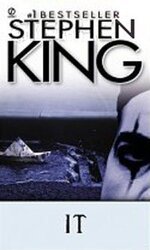
A promise made twenty-eight years ago calls seven adults to reunite in Derry, Maine, where as teenagers they battled an evil creature that preyed on the city’s children. Unsure that their Losers Club had vanquished the creature all those years ago, the seven had vowed to return to Derry if IT should ever reappear. Now, children are being murdered again and their repressed memories of that summer return as they prepare to do battle with the monster lurking in Derry’s sewers once more.
Авторы: King Stephen Edwin
see her going home with her husband, sitting beside him in the car with her hands folded as the heater hissed and he talked about his day. He could see her making them dinner. An odd thought crossed his mind and a cocktail-party question rose to his lips: Do you have children, Mrs Douglas?
‘I often think at this time of the year that people really weren’t meant to live this far north of the equator,’ she said. ‘At least not in this latitude.’ Then she smiled and some of the strangeness either went out of her face or his eye — he was able to see her, at least partially, as he always had. But you’ll never see her that way again, not completely, he thought, dismayed.
‘I’ll feel old until spring, and then I’ll feel young again. It’s that way every year. Are you sure you’ll be all right, Ben?’
‘I’ll be fine.’
‘Yes, I suppose you will. You’re a good boy, Ben.’
He looked back at his toes, blushing, loving her more than ever.
In the hallway Mr Fazio said: ‘Be careful of de fros’bite, boy,’ without looking up from his red sawdust.
‘I will.’
He reached his locker, opened it, and yanked on his snowpants. He had been painfully unhappy when his mother insisted he wear them again this winter on especially cold days, thinking of them as baby clothes, but he was glad to have them this afternoon. He walked slowly toward the door, zipping his coat, yanking the drawstrings of his hood tight, pulling on his mittens. He went out and stood on the snowpacked top step of the front stairs for a moment, listening as the door snicked closed — and locked — behind him.
Derry School brooded under a bruised skin of sky. The wind blew steadily. The snap-hooks on the flagpole rope rattled a lonesome tattoo against the steel pole itself. That wind cut into the warm and unprepared flesh of Ben’s face at once, numbing his cheeks.
Be careful of de fros’bite, boy.
He quickly pulled his scarf up until he looked like a small, pudgy caricature of Red Ryder. That darkening sky had a fantastical sort of beauty, but Ben di d not pause to admire it; it was too cold for that. He got going.
At first the wind was at his back and things didn’t seem so bad; in fact, it actually seemed to be helping him along. At Canal Street, however, he had to turn right and almost fully into the wind. Now it seemed to be holding him back . . . as if it had business with him. His scarf helped a little, but not enough. His eyes throbbed and the moisture in his nose froze to a crack-glaze. His legs were going numb. Several times he stuck his mittened hands into his armpits to warm them up. The wind whooped and screamed, sometimes sounding almost human.
Ben felt both frightened and exhilarated. Frightened because he could now understand stories he had read, such as Jack London’s ‘To Build a Fire,’ where people actually froze to death. It would be all too possible to freeze to death on a night like this, a night when the temperature would drop to fifteen below.
The exhilaration was hard to explain. It was a lonely feeling — a somehow melancholy feeling. He was outside; he passed on the wings of the wind, and none of the people beyond the brightly lighted squares of their windows saw him. They were inside, inside where there was light and warmth. They didn’t know he had passed them; only he knew. It was a secret thing.
The moving air burned like needles, but it was fresh and clean. White smoke jetted from his nose in neat little streams.
And as sundown came, the last of the day a cold yellowy-orange line on the western horizon, the fir st stars cruel diamond-chips glimmering in the sky overhead, he came to the Canal. He was only three blocks from home now, and eager to feel the heat on his face and legs, moving the blood again, making it tingle.
Still — he paused.
The Canal was frozen in its concrete sluice like a frozen river of rose-milk, its surface humped and cracked and cloudy. It was moveless yet completely alive in this harshly puritanical winterlight; it had its own unique and difficult beauty.
Ben turned the other way — southwest. Toward the Barrens. When he looked in this direction, the wind was at his back again. It made his snowpants ripple and flap. The Canal ran straight between its concrete walls for perhaps half a mile; then the concrete was gone and the river sprawled its way into the Barrens, at this time of the year a skeletal world of icy brambles and jutting naked branches.
A figure was standing on the ice down there.
Ben stared at it and thought: There may be a man down there, but can he be wearing what it looks like he’s wearing? It’s impossible, isn’t it?