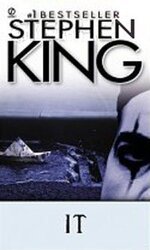
A promise made twenty-eight years ago calls seven adults to reunite in Derry, Maine, where as teenagers they battled an evil creature that preyed on the city’s children. Unsure that their Losers Club had vanquished the creature all those years ago, the seven had vowed to return to Derry if IT should ever reappear. Now, children are being murdered again and their repressed memories of that summer return as they prepare to do battle with the monster lurking in Derry’s sewers once more.
Авторы: King Stephen Edwin
have slipped into a comber (that was another thing Bill had learned from Drs Casey and Kildare; you never went into a comber; you always slipped into one).
He trotted downstream, glancing back once. He saw Ben Hanscom grimly collecting rocks from the edge of the water. For a moment Bill couldn’t figure out what he was doing, and then he understood. It was an ammo dump. Just in case they came back.
4
The Barrens were no mystery to Bill. He had played here a lot this spring, sometimes with Richie, more frequently with Eddie, sometimes all by himself. He had by no means explored the whole area, but he could find his way back to Kansas Street from the Kenduskeag with no trouble, and now did. He came out at a wooden bridge where Kansas Street crossed one of the little no –name streams that flowed out of the Derry drainage system and into the Kenduskeag down below. Silver was stashed under this bridge, his handlebars tied to one of the bridge supports with a hank of rope to keep his wheels out of the water.
Bill untied the rope, stuck it in his shirt, and hauled Silver up to the sidewalk by main force, panting and sweating, losing his balance a couple of times and landing on his tail.
But at last it was up. Bill swung his leg over the high fork.
And as always, once he was on Silver he became someone else.
5
‘Hi-yo Silver AW A YYY!’
The words came out deeper than his normal speaking voice — it was almost the voice of the man he would become. Silver gained speed slowly, the quickening clickety-ciack of the
Bicycle playing cards clothespinned to the spokes marking the increase. Bill stood on the pedals, his hands clamped on the bike– g r ips with the wrists turned up. He looked like a man trying to lift a stupendously heavy barbell. Cords stood out on his neck. Veins pulsed in his temples. His mouth was turned down in a trembling sneer of effort as he fought the familiar battle against weight and inertia, busting his brains to get Silver moving.
As always, it was worth the effort.
Silver began to roll along more briskly. Houses slid past smoothly instead of just poking by. On his left, where Kansas Street crossed Jackson, the unfettered Kenduskeag became the Canal. Past the intersection Kansas Street headed swiftly downhill toward Center and Main, Berry’s business district.
Streets crossed frequently here but they were all stop-signed in Bill’s favor, and the possibility that a driver might one day blow by one of those stop signs and flatten him to a bleeding shadow on the street had never crossed Bill’s mind. It is unlikely he would have changed his ways even if it had. He might have done so either earlier or later in his life, bu t this spring and early summer had been a strange thundery time for him. Ben would have been astounded if someone were to ask him if he was lonely; Bill would have been likewise astounded if someone asked him if he was courting death. Of cuh-cuh-course n-not! he would have responded immediately (and indignantly), but that did not change the fact that his runs down Kansas Street to town had become more and more like banzai charges as the weather warmed.
This section of Kansas Street was known as Up-Mile Hill. Bill took it at full speed, bent over Silver’s handlebars to cut down the wind resistance, one hand poised over the cracked rubber bulb of his oogah-horn to warn the unwary, his red hair blowing back from his head in a rippling wave. The click of the playing cards had mounted to a steady roar. The effortful sneer had become a big goofball grin. The residences on the right had given way to business buildings (warehouses and meat-packing plants, most of them) which blurred by in a scary but satisfying rush. To his left the Canal was a wink of fire in the corner of his eye.
‘HI-YO SILVER, AWAYYYY!’ he screamed triumphantly.
Silver flew over the first curbing, and as they almost always did at that point, his feet lost contact with the pedals. He was freewheeling, now wholly in the lap of whatever god has been appointed the job of protecting small boys. He swerved into the street, doing maybe fifteen miles an hour over the posted speed of twenty-five.
It was all behind him now: his stutter, his dad’s blank hurt eyes as he puttered around his garage workshop, the terrible sight of the dust on the closed piano cover upstairs — dusty because his mother didn’t play anymore. The last time had been at George’s funeral, three Methodist hymns. George going out into the rain, wearing his yellow slicker, carrying the newspaper boat with its glaze of paraffin; Mr Gardener coming up the street