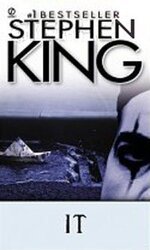
A promise made twenty-eight years ago calls seven adults to reunite in Derry, Maine, where as teenagers they battled an evil creature that preyed on the city’s children. Unsure that their Losers Club had vanquished the creature all those years ago, the seven had vowed to return to Derry if IT should ever reappear. Now, children are being murdered again and their repressed memories of that summer return as they prepare to do battle with the monster lurking in Derry’s sewers once more.
Авторы: King Stephen Edwin
a gull screamed somewhere and Mike flinched, thinking again of the bird he had seen that day, that day just this spring.
Whatever that is in the grass, I don’t even want to look at it. And that was oh so very true, but here he was, already bending over it, hands planted just above his knees, to see what it was.
A tattered bit of cloth with a drop of blood on it.
The seagull screamed again. Mike stared at the bloody scrap of cloth and remembered what had happened to him in the spring.
5
Each year during April and May the Hanlon farm woke up from its winter doze.
Mike would let himself know that spring had come again not when the first crocuses showed under his mom’s kitchen windows or when kids started bringing immies and croakers to school or even when the Washington Senators kicked off the baseball season (usually getting themselves shellacked in the process), but only when his father hollered for Mike to help him push their mongrel truck out of the barn. The front half was an old Model-A Ford car, the back end a pick-up truck with a tailgate which was the remainder of the old henhouse door. If the winter hadn’t been too cold, the two of them could often get it going by pushing it down the driveway. The truck’s cab had no doors; likewise there was no windshield. The seat was half of an old sofa that Will Hanlon had scrounged from the Derry dump. The stick-shift ended in a glass doorknob.
They would push it down the driveway, one on each side, and when it got rolling good, Will would jump in, turn on the switch, retard the spark, step down on the clutch, punch the shift into first gear with his big hand clamped over the doorknob. Then he would holler: ‘Put me over the hump!’ He’d pop the clutch and the old Ford engine would cough, choke, chug, backfire . . . and sometimes actually start to run, rough at first, then smoothing out. Will would roar down the road toward Rhulin Farms, turn around in their driveway (if he had gone the other way, Henry Bowers’s crazy father Butch probably would have blown his head off with a shotgun), and then roar back, the unmuffled engine blatting stridently while Mike jumped up and down with excitement, cheering, and his mom stood in the kitchen doorway, wiping her hands on a dishtowel and pretending a disgust she didn’t really feel.
Other times the truck wouldn’t roll-start and Mike would have to wait until his father came back from the barn, carrying the crank and muttering under his breath. Mike was quite sure that some of the words so muttered were swears, and he would be a little frightened of his daddy then. (It wasn’t until much later, during one of those interminable visits to the hospital room where Will Hanlon lay dying, that he found out his father muttered because he was afraid of the crank: once it had kicked back viciously, flown out of its socket, and torn the side of his mouth open.)
‘Stand back, Mikey,’ he would say, slipping the crank into its socket at the base of the radiator. And when the A was finally running, he’d say that next year he was going to trade it fo r a Chevrolet, but he never did. That old A-Ford hybrid was still in back of the home place, up to its axles and henhouse tailgate in weeds.
When it was running, and Mike was sitting in the passenger seat, smelling hot oil and blue exhaust, excited by the keen breeze that washed in through the glassless hole where the windshield had once been, he would think: Spring’s here again. We’re all waking up. And in his soul he would raise a silent cheer that shook the wails of that mostly cheerful room. He felt love for everything around him, and most of all for his dad, who would grin over at him and holler: ‘Hold on, Mikey! We gone wind this baby up! We gone make some birds run for cover!’
Then he would tear up the driveway, the A’s rear wheels spitting back black dirt and gray clods of clay, both of them jouncing up and down on the sofa-seat inside the open cab, laughing like stark natural-born fools. Will would run the A through the high grass of the back field, which was kept for hay, toward either the south field (potatoes), the west field (corn and beans), or the east field (peas, squash, and pumpkins). As they went, birds would burst up out of the grass before the truck, squawking in terror. Once a partridge flew up, a magnificent bird as brown as late-autumn oaks, the explosive coughing whirr of its wings audible even over the pounding engine.
Those rides were Mike Hanlon’s door into spring.
The year’s work began with the rock harvest. Every day for a week they would take the A out and load the bed with rocks which might break a harrow-blade when the