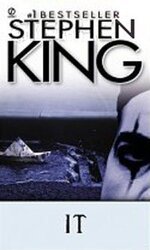
A promise made twenty-eight years ago calls seven adults to reunite in Derry, Maine, where as teenagers they battled an evil creature that preyed on the city’s children. Unsure that their Losers Club had vanquished the creature all those years ago, the seven had vowed to return to Derry if IT should ever reappear. Now, children are being murdered again and their repressed memories of that summer return as they prepare to do battle with the monster lurking in Derry’s sewers once more.
Авторы: King Stephen Edwin
the next three weeks all of them would work picking potatoes. In addition to the family, Will would hire three or four high-school boys to help pick, paying them a quarter a barrel. The A-Ford would cruise slowly up and down the rows of the south field, the biggest field, always in low gear, the tailgate down, th e back filled with barrels, each marked with the name of the person picking into it, and at the end of the day Will would open his old creased wallet and pay each of the pickers cash money. Mike was paid, and so was his mother; that money was theirs, and Will Hanlon never once asked either of them what they did with it. Mike had been given a five-percent interest in the farm when he was five years old — old enough, Will had told him then, to hold a hoe and to tell the difference between witchgrass and pea-plants. Each year he had been given another one percent, and each year, on the day after Thanksgiving, Will would compute the farm’s profits and deduct Mike’s share . . . but Mike never saw any of that money. It went into his college account and was to be touched under absolutely no other circumstances.
At last the day would come when Normie Sadler drove his potato– digger back home; by then the air would have most likely turned gray and cold and there would be frost on the drift of orange pumpkins piled against the side of the barn. Mike would stand in the dooryard, his nose red, his dirty hands stuffed into his jeans pockets, and watch as his father drove first the tractor and then the A-Ford back into the barn. He would think: We’re getting ready to go tosleep again. Spring . . . vanished. Summer . . . gone. Harvest-time . . . done. All that was left now was the butt end of autumn: leafless trees, frozen ground, a lacing of ice along the banks of the Kenduskeag. In the fields, crows would sometimes land on the shoulders of Moe, Larry, and Curly, and stay as long as they liked. The scarecrows were voiceless, threatless.
Mike would not exactly be dismayed by the thought of another year ending — at nine and ten he was still too young to make mortal metaphors — because there was plenty to look forward to: sledding in McCarron Park (or on Rhulin Hill out here in Derrytown if you were brave, although that was mostly for big kids), ice-skating, snowball fights, snowfort building. There was time to think about snowshoeing out for a Christmas tree with his daddy, and time to think about the Nordica downhill skis he might or might not get for Christmas. Winter was good . . . but watching his father drive the A back into the barn
(spring vanished summer gone harvest-time done)
always made him feel sad, the way the squadrons of birds heading south for the winter made him feel sad, or the way a certain slant of light could sometimes make him feel like crying for no good reason. We’re getting ready to go to sleep again . . .
It was not all school and chores, chores and school; Will Hanlon had told his wife more than once that a boy needed time to go fishing, even if it wasn’t fishing he was really doing. When Mike came home from school he first put his books on the TV in the parlor, second made himself some kind of snack (he was particularly partial to peanut-butter-and –onion sandwiches, a taste that made his mother raise her hands in helpless horror), and third studied the note his father had left him, telling Mike where he, Will, was and what Mike’s chores were — certain rows to be weeded or picked, baskets to be carried, produce to be rotated, the barn to be swept, whatever. But on at least one schoolday a week — and sometimes two — there would be no note. And on these days Mike would go fishing, even if it wasn’t really
fishing he was doing. Those were great days . . . days when he had no particular place to go and consequently felt no urge to get there in a hurry.
Once in awhile his father left him another sort of note: ‘No chores,’ one might say. ‘Go over to Old Cape & look at trolley tracks.’ Mike would go over to the Old Cape area, find the streets with the tracks still embedded in them, and inspect them closely, marvelling to think of things lik e trains that had run right through the middle of the streets. That night he and his father might talk about them, and his dad would show him pictures from his Derry album of the trolleys actually running: a funny pole went from the roof of the trolley up to an electrical wire, and there were cigarette ads on the side. Another time he had sent Mike to Memorial Park, where the Standpipe was, to look at the birdbath, and once they had gone to the courthouse together