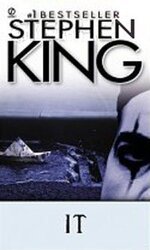
A promise made twenty-eight years ago calls seven adults to reunite in Derry, Maine, where as teenagers they battled an evil creature that preyed on the city’s children. Unsure that their Losers Club had vanquished the creature all those years ago, the seven had vowed to return to Derry if IT should ever reappear. Now, children are being murdered again and their repressed memories of that summer return as they prepare to do battle with the monster lurking in Derry’s sewers once more.
Авторы: King Stephen Edwin
to look at a terrible machine that Chief Bo rton had found in the attic. This gadget was called a tramp-chair. It was cast-iron, and there were manacles built into the arms and legs. Rounded knobs stuck out of the back and seat. It reminded Mike of a photograph he had seen in some book — a photograph of the electric chair at Sing Sing. Chief Borton let Mike sit in the tramp-chair and try on the manacles.
After the first ominous novelty of wearing the manacles wore off, Mike looked questioningly at his father and Chief Borton, not sure why this was supposed to be such a horrible punishment for the ‘vags’ (Borton’s word for them) that had drifted into town in the twenties and thirties. The knobs made the chair a little uncomfortable to sit in, sure, and the manacles on your wrists and ankles made it hard to shift to a more comfortable position, but —
‘Well, you’re just a kid,’ Chief Borton said, laughing. ‘What do you weigh? Seventy, eighty pounds? Most of the vags Sheriff Sully posted into that chair in the old days would go twice that. They’d feel a bit oncomfortable after an hour or so, really oncomfortable after two or three, and right bad after four or five. After seven or eight hours they’d staat bellerin, and after sixteen or seventeen they’d staat cryin, mostly. And by the time their twenty-four –hour tour was up, they’d be willin to swear before God and man that the next time they came riding the rods up New England way they’d give Derry a wide berth. So far as I know, most of cm did. Twenty-four hours in the tramp –chair was a helluva persuader.’
Suddenly there seemed to be more knobs in the chair, digging more deeply into his buttocks, spine, the small of his back, even the nape of his neck. ‘Can I get out now, please?’ he said politely, and Chief Borton laughed again. There was a moment, one panicked instant of time, when Mike thought the Chief would only dangle the key to the manacles in front of Mike’s eyes and say, Sure I’ll let you out . . . when your twenty-four hours is up.
‘Why did you take me there, Daddy?’ he asked on the way home.
‘You’ll know when you’re older,’ Will had replied.
‘You don’t like Chief Borton, do you?’
‘No,’ his father had replied in a voice so curt that Mike hadn’t dared ask any more.
But Mike enjoyed most of the places in Derry his father sent or took him to, and by the time Mike was ten Will had succeeded in conveying his own interest in the layers of Derry’s history to his son. Sometimes, as when he had been trailing his fingers over the slightly pebbled surface of the stand in which the Memorial Park birdbath was set, or when he had squatted down to look more closely at the trolley tracks which grooved Mont Street in the Old Cape, he would be struck by a profound sense of time . . . time as something real, as something that had unseen weight, the way sunlight was supposed to have weight (some of the kids in school had laughed when Mrs Greenguss told them that, but Mike had been too stunned by the concept to laugh; his first thought had been, Light has weight? Oh my Lord, that’s terrible!) . . time as something that would eventually bury him.
The first note his father left him in that spring of 1958 was scribbled on the back of an envelope and held down with a salt-shaker. The air was spring-warm, wonderfully sweet, and
his mother had opened all the windows. No chores, the note read. If you want to, ride yourbike out to Pasture Road. You’ll see a lot of tumbled masonry and old machinery out in the field on your left. Have a look around, bring back a souvenir. Don’t go near the cellarhole! And be back before dark. You know why.
Mike knew why, all right.
He told his mother where he was going and she frowned. ‘Why don’t you see if Randy Robinson wants to go with you?’
‘Yeah, okay, I’ll stop by and ask him,’ Mike said.
He did, too, but Randy had gone up to Bangor with his father to buy seedling potatoes. So Mike rode his bike over to Pasture Road alone. It was a goodish ride — a little over four miles. Mike reckoned it was three o’clock by the time he leaned his bike against an old wooden slat-fence on the left side of Pasture Road and climbed into the field beyond. He would have maybe an hour to explore and then he would have to start home again. Ordinarily, his mother would not be upset with him as long as he was back by six, when she put dinner on the