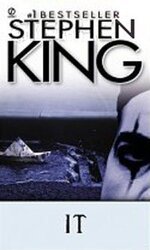
A promise made twenty-eight years ago calls seven adults to reunite in Derry, Maine, where as teenagers they battled an evil creature that preyed on the city’s children. Unsure that their Losers Club had vanquished the creature all those years ago, the seven had vowed to return to Derry if IT should ever reappear. Now, children are being murdered again and their repressed memories of that summer return as they prepare to do battle with the monster lurking in Derry’s sewers once more.
Авторы: King Stephen Edwin
coquetry on Adrian’s part this night; he recognized that they were in a lot of trouble.
‘Give me that hat,’ Garton said. ‘Give it to me, queer.’
‘If I do, will you leave us alone?’ Adrian was wheezing with fright, almost crying, looking from Unwin to Dubay to Garton with terrified eyes.
‘Just give me the fucker!’
Adrian handed it over. Garton produced a switchknife from the left front pocket of his jeans and cut it into two pieces. He rubbed the pieces against the seat of his jeans. Then he dropped them to his feet and stomped them.
Don Hagarty backed away a little while their attention was divided between Adrian and the hat — he was looking, he said, for a cop.
‘Now will you let us al — ‘ Adrian Mellon began, and that was when Garton punched him in the face, driving him back against the waist– high pedestrian ra i l i n g o f t h e b r i d g e . A d r i a n screamed, clapping his hands to his mouth. Blood poured through his fingers.
‘Ade!’ Hagarty cried, and ran forward again. Dubay tripped him. Garton booted him in the stomach, knocking him off the sidewalk and into the roadway. A car passed. Hagarty rose to his knees and screamed at it. It didn’t slow. The driver, he told Gardener and Reeves, never even looked around.
‘Shut up, queer!’ Dubay said, and kicked him in the side of the face. Hagarty fell on his side in the gutter, semiconscious.
A few moments later he heard a voice — Chris Unwin’s — telling him to get away before he got what his friend was getting. In his own statement Unwin verified giving this warning.
Hagarty could hear thudding blows and the sound of his lover screaming. Adrian sounded like a rabbit in a snare, he told the police. Hagarty crawled back toward the intersection and the bright lights of the bus station, and when he was a distance away he turned back to look.
Adrian Mellon, who stood about five-five and might have weighed a hundred and thirty-five pounds soaking wet, was being pushed from Garton to Dubay to Unwin in a kind of triple play. His body jittered and flopped like the body of a rag doll. They were punching him, pummelling him, ripping at his clothes. As he watched, he said, Garton punched Adrian in the crotch. Adrian’s hair hung in his face. Blood poured out of his mouth and soaked his shirt. Webby Garton wore two heavy rings on his right hand: one was a Derry High School ring, the other one he had made in shop class — an intertwined brass DB stood out three inches from this latter. The letters stood for the Dead Bugs, a metal band he particularly admired. The rings had torn Adrian’s upper lip open and shattered three of his upper teeth at the gum line.
‘Help!’ Hagarty shrieked. ‘Help! Help! They’re killing him! Help!’
The buildings of Main Street loomed dark and secret. No one came to help — not even from the one white island of light which marked the bus station, and Hagarty did not see how that could be: there were people in there. He had seen them when he and Ade walked past. Would none of them come to help? None at all?
‘HELP! HELP! THEY’RE KILLING HIM, HELP, PLEASE, FOR GOD’S SAKE!’
‘Help,’ a very small voice whispered from Don Hagarty’s left . . . and then there was a giggle.
‘Bum’s rush!’ Garton was yelling now . . . yelling and laughing. All three of them, Hagarty told Gardener and Reeves, had been laughing while they beat Adrian up. ‘Bum’s rush! Overthe side!’
‘Bum’s rush! Bum’s rush! Bum’s rush!’ Dubay chanted, laughing.
‘Help,’ the small voice said again, and although the voice was grave, that little giggle followed again — it was like the voice of a child who cannot help itself.
Hagarty looked down and saw the clown — and it was at this point that Gardener and Reeves began to discount everything that Hagarty said, because the rest was the raving of a lunatic. Later, however, Harold Gardener found himself wondering. Later, when he found tha t the Unwin boy had also seen a clown — or said he had — he began to have second thoughts. His partner either never had them or would never admit to them.
The clown, Hagarty said, looked like a cross between Ronald McDonald and that old TV clown, Bozo — or so he thought at first. It was the wild tufts of orange hair that brought such comparisons to mind. But later consideration had caused him to think the clown really looked like neither. The smile painted over the white pancake was red, not orange, and the eyes were a weird shiny silver. Contact lenses, perhaps . . . but a part of him thought then and continued to think that maybe that silver had been the real color of those eyes.