
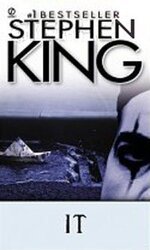
A promise made twenty-eight years ago calls seven adults to reunite in Derry, Maine, where as teenagers they battled an evil creature that preyed on the city’s children. Unsure that their Losers Club had vanquished the creature all those years ago, the seven had vowed to return to Derry if IT should ever reappear. Now, children are being murdered again and their repressed memories of that summer return as they prepare to do battle with the monster lurking in Derry’s sewers once more.
Авторы: King Stephen Edwin
disbelief. An urge came to him then, an urge to spring to his feet and shout: What a crazy story! You don’t believe that crazy story, do you, and even if you do, you don’t believe we believe it, do you? School pictures can’t wink! Books can’t bleed! You’re out of your mind, Big Bill!
But he couldn’t very well do so, because that expression of solemn fear was also on his own face. He couldn’t see it but he could feel it.
Come back here, kid, the hoarse voice whispered. I’ll blow you for free. Come back here!
No, Eddie moaned at it. Please, go away, I don’t want to think about that.
Come back here, kid.
And now Eddie saw something else — not on Richie’s face, at least he didn’t think so, but on Stan’s and Ben’s for sure. He knew what that something else was; knew because that expression was on his own face, too.
Recognition.
‘I’ll blow you for free.
The house at 29 Neibolt Street was just outside the Derry trainyards. It was old and boarded up, its porch gradually sinking back into the ground, its lawn an overgrown field. An old trike, rusting and overturned, hid in that long grass, one wheel sticking up at an angle.
But on the left side of the porch there was a huge bald patch in the lawn and you could see dirty cellar windows set into the house’s crumbling brick foundation. It was in one of those windows that Eddie Kaspbrak first saw the face of the leper six weeks ago.
6
On Saturdays, when Eddie could find no one to play with, he often went down to the trainyards. No real reason; he just liked to go out there.
He would ride his bike out Witcham Street and then cut to the northwest along Route 2 where it crossed Witcham. The Neibolt Street Church School stood on the corner of Route 2 and Neibolt Street a mile or so farther on. It was a shabby-neat wood-frame building with a large cross on top and the words SUFFER THE LITTLE CHILDREN TO COME UNTO ME written over the front door in gilt letters two feet high. Sometimes, on Saturdays, Eddie heard music and singing coming from inside. It was gospel music, but whoever was playing the piano sounded more like Jerry Lee Lewis than a regular church piano player. The singing didn’t sound very religious to Eddie, either, although there was lots of stuff in it about ‘beautiful Zion’ and being ‘washed in the blood of the lamb’ and ‘what a friend we have in Jesus.’ The people singing seemed to be having much too good a time for it to really be sacred singing, in Eddie’s opinion. But he liked the sound of it all the same — the way he liked to hear Jerry Lee hollering out ‘Whole Lotta Shakin’ Goin’ On.’ Sometimes he would stop for awhile across the street, leaning his bike against a tree and pretending to read on the grass, actually jiving along to the music.
Other Saturdays the Church School would be shut up and silent and he would ride out to the trainyard without stopping, out to where Neibolt Street ended in a parking lot with weeds growing up through the cracks in the asphalt. There he would lean his bike against the wooden fence and watch the trains go by. There were a lot of them on Saturdays. His mother told him that in the old days you could catch a GS&WM passenger train at what was then Neibolt Street Station, but the passenger trains had stopped running around the time the Korean War was starting up. ‘If you got on the northbound train you went to Brownsville Station,’ she said, ‘and from Brownsville you could catch a train that would take you all the way across Canada if you wanted, all the way to the Pacific. The southbound tram would take you to Portland and then on down to Boston, and from South Station the country was yours. But the passenger trains have gone the way of the trolley lines now, I guess. No one wants to ride a train when they can just jump in a Ford and go. You may never even ride one.’
But great long freights still came through Derry. They headed south loaded down with pulpwood, paper, and potatoes, and north with manufactured goods for those towns of what Maine people sometimes called the Big Northern — Bangor, Millinocket, Machias, Presque Isle, Houlton. Eddie particularly liked to watch the northbound car-carriers with their loads of gleaming Fords and Chevies. I’ll have me a car like one of those someday,