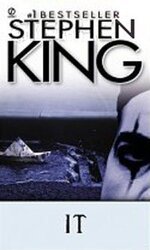
A promise made twenty-eight years ago calls seven adults to reunite in Derry, Maine, where as teenagers they battled an evil creature that preyed on the city’s children. Unsure that their Losers Club had vanquished the creature all those years ago, the seven had vowed to return to Derry if IT should ever reappear. Now, children are being murdered again and their repressed memories of that summer return as they prepare to do battle with the monster lurking in Derry’s sewers once more.
Авторы: King Stephen Edwin
Stan sat down on a bench, took his bird-album out of the bag, and turned over to the picture of the cardinal one more time, going over it, familiarizing himself with the recognizable points. A male cardinal would be hard to mistake for something else — it was as red as a fire-engine, if not so large — but Stan was a creature of habit and convention; these things comforted him and reinforced his sense of place and belonging in the world. So he gave the picture a good three-minute study before closing the book (the moisture in the air was making the corners of the pages turn up) and putting it back into the bag. He uncased his binoculars and put them to his eyes. There was no need to adjust the field of focus, because the last time he had used the glasses he had been sitting on this same bench and looking at that same birdbath.
Fastidious boy, patient boy. He did not fidget. He did not get up and walk around or swing the binoculars here and there to see what else there might be to be seen. He sat still, field glasses trained on the birdbath, and the mist collected in fat drops on his yellow slicker.
He was not bored. He was looking down into the equivalent of an avian convention-site. Four brown sparrows sat there for awhile, dipping into the water with their beaks, flicking droplets casually back over their shoulders and onto their backs. Then a bluejay came hauling in like a cop breaking up a gaggle of loiterers. The jay was as big as a house in Stan’s glasses, his quarrelsome cries absurdly thin by comparison (after you looked through the binoculars steadily for awhile the magnified birds you saw began to seem not odd but perfectly correct). The sparrows flew off. The jay, now in charge, strutted, bathed, grew bored, departed. The sparrows returned, then flew off again as a pair of robins cruised in to bathe and (perhaps) to discuss matters of importance to the hollow-boned set. Stan’s father had laughed at Stan’s hesitant suggestion that maybe birds talked, and he was sure his dad was right when he said birds weren’t smart enough to talk — that their brain –pans were too small — but by gosh they sure looked like they were talking. A new bird joined them. It was red. Stan hastily adjusted the field of focus on the binoculars a bit. Was it . . . ? No. It was a scarlet tanager, a good bird but not the cardinal he was looking for. It was joined by a flicker that was a frequent visitor to the Memorial Park birdbath. Stan recognized him by the tattered right wing. As always, he speculated on how that might have happened — a close call with some cat seemed the most likely explanation. Other birds came and went. Stan saw a grackle, as clumsy and ugly as a flying boxcar, a bluebird, another flicker. He was finally rewarded by a new bird — not the cardinal but a cowbird that looked vast and stupid in the eyepieces of the binoculars. He dropped them against his chest and fumbled the bird-book out of the bag again, hoping that the cowbird wouldn’t fly away before he could confirm the sighting. He would have something to take home to his father, at least. And it was time to go. The light was fading fast. He felt cold and damp. He checked the book, then lo oked through the glasses again. It was still there, not bathing but only standing on the rim of the birdbath looking dumb. It was almost surely a cowbird. With no distinctive markings — at least none he could pick up at this distance — and in the fading light it was hard to be one hundred percent sure, but maybe he had just enough time and light for one more check. He looked at the picture in the book, studying it with a fierce frown of concentration, and then picked up the glasses again. He had only fixed them on the birdbath when a hollow rolling boom! sent the cowbird — if it had
been a cowbird — winging. Stan tried to follow it with the glasses, knowing how slim his chances were of picking it up again. He lost it and made a hissing sound of disgust between his teeth. Well, if it had come once it would perhaps come again. And it had only been a cowbird
(probably a cowbird)
after all, not a golden eagle or a great auk.
Stan recased his binoculars and put away his bird-album. Then he got up and looked around to see if he could tell what had been responsible for that sudden loud noise. It hadn’t sounded like a gun or a car backfire. More like a door being thrown open in a spooky movie about castles and dungeons . . . complete with hokey echo effects.
He could see nothing.
He got up and started toward the slope down to Kansas Street. The Standpipe was now on his right, a chalky white cylinder, phantomlike in the mist and the growing darkness. It seemed almost to . . . to float.
That was an odd thought. He supposed it must have come from his own head — where else could