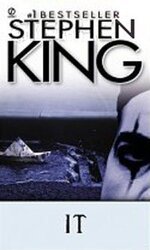
A promise made twenty-eight years ago calls seven adults to reunite in Derry, Maine, where as teenagers they battled an evil creature that preyed on the city’s children. Unsure that their Losers Club had vanquished the creature all those years ago, the seven had vowed to return to Derry if IT should ever reappear. Now, children are being murdered again and their repressed memories of that summer return as they prepare to do battle with the monster lurking in Derry’s sewers once more.
Авторы: King Stephen Edwin
louder, as if to mask the sound of the footsteps. He could recognize the tune now — it was ‘Camptown Races.’
Footsteps, yeah: but they weren’t exactly rustling footsteps, were they? They actually sounded kind of . . . squishy, didn’t they? The sound was like people walking in rubbers full of water.
Camptown ladies sing dis song, doodah doodah
(Squish-squish)
Camptown Racetrack nine miles long, doodah doodah
(Squish-slosh — closer now)
Ride around all night
Ride around all day . . .
Now there were shadows bobbing on the wall above him.
The terror leaped down Stan’s throat all at once — it was like swallowing something hot and horrible, bad medicine that suddenly galvanized you like electricity. It was the shadows that did it.
He saw them only for a moment. He had just that small bit of time to observe that there were two of them, that they were slumped, and somehow unnatural. He had only that moment because the light in here was fading, fading too fast, and as he turned, the heavy Standpipe door swung ponderously shut behind him.
Stanley ran back down the stairs (somehow he had climbed more than a dozen, although he could only remember climbing two, three at most), very much afraid now. It was too dark in here to see anything. He could hear his own breathing, he could hear die calliope tootling away somewhere above him
(what’s a calliope doing up there in the dark? who’s playing it?)
and he could hear those wet footsteps. Approaching him now. Getting closer.
He hit the door with his hands splayed out in front of him, hit it hard enough to send sparkly tingles of pain all the way up to his elbows. It had swung so easily before . . . and now it would not move at all.
No . . . that was not quite true. At first it ha d moved just a bit, just enough for him to see a mocking strip of gray light running vertically down its left side. Then gone again. As if someone was on the other side of it, holding the door closed.
Panting, terrified, Stan pushed against the door with all of his strength. He could feel the brass bindings digging into his hands. Nothing.
He whirled around, now pressing his back and his splayed hands against the door. He could feel sweat, oily and hot, running down his forehead. The calliope music had gotten louder yet. It drifted and echoed down the spiral staircase. There was nothing cheery about it now. It had changed. It had become a dirge. It screamed like wind and water, and in his mind’s eye Stan saw a county fair at the end of autumn, wind and rain blowing up a deserted midway, pennons flapping, tents bulging, falling over, wheeling away like canvas bats. He saw empty rides standing against the sky like scaffolds; the wind drummed and hooted in the weird angles of their struts. He suddenly understood that death was in this place with him, that death was coming for him out of the dark and he could not run.
A sudden rush of water spilled down the stairs. Now it was not popcorn and doughboys and cotton candy he smelled but wet decay, the stench of dead pork which has exploded in a fury of maggots in a place hidden away from the sun.
‘Who’s here?’ he screamed in a high, trembling voice.
He was answered by a low, bubbling voice that seemed choked with mud and old water.
‘The dead ones, Stanley. We’re the dead ones. We sank, but now we float . . . and you’ll float, too.’
He could feel water washing around his feet. He cringed back against the door in an agony of fear. They were very close now. He could feel their nearness. He could smell them. Something was digging into his hip as he struck the door again and again in a mindless, useless effort to get away.
‘We’re dead, but sometimes we clown around a little, Stanley. Sometimes we — ‘
It was his bird-book.
Without think ing, Stan grabbed for it. It was stuck in his slicker pocket and wouldn’t come out. One of them was down now; he could hear it shuffling across the little stone areaway where he had come in. It would reach for him in a moment, and he would feel its cold flesh.
He gave one more tremendous yank, and the bird-book was in his hands. He held it in front of him like a puny shield, not thinking of what he was doing, but suddenly sure that this was right.
‘Robins!’ he screamed into the darkness, and for a moment the thing approaching (it was surely less than five steps away now) hesitated