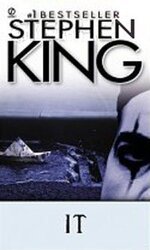
A promise made twenty-eight years ago calls seven adults to reunite in Derry, Maine, where as teenagers they battled an evil creature that preyed on the city’s children. Unsure that their Losers Club had vanquished the creature all those years ago, the seven had vowed to return to Derry if IT should ever reappear. Now, children are being murdered again and their repressed memories of that summer return as they prepare to do battle with the monster lurking in Derry’s sewers once more.
Авторы: King Stephen Edwin
and a lot of people don’t even know there was such a thing. I think it might be because most of the histories have been written by Northerners and they’re ashamed.
‘It was most pop’lar in the big cities and the manufacturin areas. New York, New Jersey, Detroit, Baltimore, Boston, Portsmouth — they all had their chapters. They tried to organize in Maine, but Derry was the only place they had any real success. Oh, for awhile there was a pretty good chapter in Lewiston — this was around the same time as the fire at the Black Spot — but they weren’t worried about niggers raping white women or taking jobs that should have belonged to white men, because there weren’t any niggers to speak of up here. In Lewiston they were worried about tramps and hobos and that something called «the bonus army» would join up with something they called «the Communist riffraff army,» by which they meant any man who was out of work. The Legion of Decency used to send these fellows out of town just as fast as they came in. Sometimes they stuffed poison ivy down the backs of their pants. Sometimes they set their shirts on fire.
‘Well, the Legion was pretty much done up here after the fire at the Black Spot. Things got out of hand, you see. The way things seem to do in this town, sometimes.’
He paused, puffing.
‘It’s like the Legion of White Decency was just another seed, Mikey, and it found some earth that nourished it well here. It was a regular rich-man’s club. And after the fire, they all
just laid away their sheets and lied each other up and it was papered over.’ Now there was a kind of vicious contempt in his voice that made my mother look up, frowning. ‘After all, who got killed? Eighteen army niggers, fourteen or fifteen town niggers, four members of a nigger jazz-band . . . a nd a bunch of nigger –lovers. What did it matter?’
‘Will,’ my mother said softly. That’s enough.’
‘No,’ I said. ‘I want to hear!’
‘It’s getting to be your bedtime, Mikey,’ he said, ruffling my hair with his big, hard hand. ‘I just want to tell you one thing more, and I don’t think you’ll understand it, because I’m not sure I understand it myself. What happened that night at the Black Spot, bad as it was . . . I don’t really think it happened because we was black. Not even because the Spot was close behind West Broadway, where the rich whites in Derry lived then and still live today. I don’t think that the Legion of White Decency happened to get along so well here because they hated black people and bums more in Derry than they did in Portland or Lewiston or Brunswick. It’s because of that soil. It seems that bad things, hurtful things, do right well in the soil of this town. I’ve thought so again and again over the years. I don’t know why it should be . . . but it is.
‘But there are good folks here too, and there were good folks here then. When the funerals were held afterward, thousands of people turned out, and they turned out for the blacks as well as the whites. Businesses closed up for most of a week. The hospitals treated the hurt ones free of charge. There were food baskets and letters of condolence that were honestly meant. And there were helping hands held out. I met my friend Dewey Conroy during that time, and you know he’s just as white as vanilla ice cream, but I feel like he’s my brother. I’d die for Dewey if he asked me to, and although no man really knows another man’s heart, I think he’d die for me if it came to that.
‘Anyway, the army sent away those of us that were left after that fire, like they were ashamed . . . and I guess they were. I ended up down at Fort Hood, and I stayed there for six years. I met your mother there, and we were married in Galveston, at her folks’ house. But ail through the years between, Derry never escaped my mind. And after the war, I brought your mo m back here. And we had you. And here we are, not three miles from where the Black Spot stood in 1930. And I think it’s your bedtime, Mr Man.’
‘I want to hear about the fire!’ I yelled. ‘Tell me about it, Daddy!’
And he looked at me in that frowning way that always shut me up . . . maybe because he didn’t look that way often. Mostly he was a smiling man. ‘That’s no story for a boy,’ he said. ‘Another time, Mikey. When we’ve both walked around a few more years.’
As it turned out, we both walked around another four years before I heard the story of what happened at the Black Spot that night, and by then my father’s walking days were all done. He told me from the hospital bed where he lay, full of dope, dozing in and out of reality as the cancer worked away inside of his intestines, eating him up.
February 26th, 1985
I got reading over what I had written last in this notebook and surprised myself by bursting into tears over my father, who has now been dead for twenty-three years. I can remember