
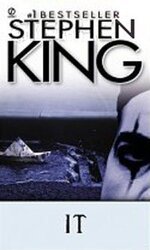
A promise made twenty-eight years ago calls seven adults to reunite in Derry, Maine, where as teenagers they battled an evil creature that preyed on the city’s children. Unsure that their Losers Club had vanquished the creature all those years ago, the seven had vowed to return to Derry if IT should ever reappear. Now, children are being murdered again and their repressed memories of that summer return as they prepare to do battle with the monster lurking in Derry’s sewers once more.
Авторы: King Stephen Edwin
my grief for him — it lasted for almost two years. Then when I graduated from high school in 1965 and my mother looked at me and said, ‘How proud your father would have been!,’ we cried in each other’s arms and I thought that was the end, that we had finished the job of burying him with those late tears. But who knows how long a grief may last? Isn’t it possible that, even thirty or forty years after the death of a child or a brother or a sister, one may half-waken, thinking of that person with that same lost emptiness, that feeling of places which
may never be filled . . . perhaps not even in death?
He left the army in 1937 with a disability pension. By that year, my father’s army had become a good deal more warlike; anyone with half an eye, he told me once, could see by then that soon all the guns would be coming out of storage again. He had risen to the rank of sergeant in the interim, and he had lost most of his left foot when a new recruit who was so scared he was almost shitting peach-pits pulled the pin on a hand grenade and then dropped it instead of throwing it. It rolled over to my father and exploded with a sound that was, he said, like a cough in the middle of the night.
A lot of the ordnance those long-ago soldiers had to train with was either defective or had sat so long in almost forgotten supply depots that it was impotent. They had bullets that wouldn’t fire and rifles that sometimes exploded in their hands when the bullets did fire. The navy had torpedoes that usually didn’t go where they were aimed and didn’t explode when they did. The Army Air Corps and the Navy Air Arm had planes whose wings fell off if they landed hard, and at Pensacola in 1939, I have read, a supply officer discovered a whole fleet of government trucks that wouldn’t run because cockroaches had eaten the rubber hoses and the fanbelts.
So my father’s life was saved (including, of course, the part of him that became Your Ob’dt Servant Michael Hanlon) by a combination of bureaucratic porkbarrelling folderol and defective equipment. The grenade only half-exploded and he just lost part of one foot instead of everything from the breastbone on down.
Because of the disability money he was able to marry my mother a year earlier than he had planned. They didn’t come to Derry at once; they moved to Houston, where they did war work until 1945. My father was a foreman in a factory that made bomb-casings. My mother was a Rosie the Riveter. But as he told me that night when I was eleven, the thought of Derry ‘never escaped his mind.’ And now I wonder if that blind thing might not have been at work even then, — drawing nun back so I could take my place in that circle in the Barrens that August evening. If the wheels of the universe are in true, then good always compensates for evil — but good can be awful as well.
My father had a subscription to the Derry News. He kept his eye on the ads announcing land for sale. They had saved up a good bit of money. At last he saw a farm for sale that looked like a good proposition . . . on paper, at least. The two of them rode up from Texas on a Trailways bus, looked at it, and bought it the same day. The First Merchants of Penobscot County issued my father a ten-year mortgage, and they settled down.
‘We had some problems at first,’ my father said another time. ‘There were people who didn’t want Negroes in the neighborhood. We knew it was going to be that way — I hadn’t forgotten about the Black Spot — and we just hunkered down to wait it out. Kids would go by and throw rocks or beer cans. I must have replaced twenty windows that first year. And some of them weren’t just kids, either. One day when we got up, there was a swastika painted on the side of the chickenhouse and all the chickens were dead. Someone had poisoned their feed. Those were the last chickens I ever tried to keep.
‘But the County Sheriff — there wasn’t any police chief in those days, Derry wasn’t quite big enough for such a thing — got to work on the matter and he worked hard. That’s what I mean, Mikey, when I say there is good here as well as bad. It didn’t make any difference to that man Sullivan that rny skin was brown and my hair was kinky. He come out half a dozen times, he talked to people, and finally he found out who done it. And who do you think it was? I’ll give you three guesses, and the first two don’t count!’
‘I don’t know,’ I said.
My father laughed until tears spouted out of his eyes. He took a big white handkerchief out of his pocket and wiped them away. ‘Why, it was Butch Bowers, that’s who! The father of the kid you say is the biggest bully at your school. The father’s a turd and the son’s a little fart.’
There are kids at school who say Henry’s father is crazy,’ I told him. I think I was in the fourth grade at that time — far enough along to have had my can righteously kicked by Henry Bowers