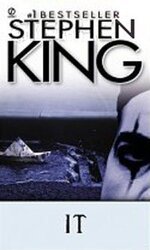
A promise made twenty-eight years ago calls seven adults to reunite in Derry, Maine, where as teenagers they battled an evil creature that preyed on the city’s children. Unsure that their Losers Club had vanquished the creature all those years ago, the seven had vowed to return to Derry if IT should ever reappear. Now, children are being murdered again and their repressed memories of that summer return as they prepare to do battle with the monster lurking in Derry’s sewers once more.
Авторы: King Stephen Edwin
I think, where one of the characters says that ‘way leads on to way’; that you could start at a path leading nowhere more fantastic than from your own front steps to the sidewalk, and from there you could go . . . well, anywhere at all. It’s the same way with stories. One leads to the next, to the next, and to the next; maybe they go in the direction you wanted to go, but maybe they don’t. Maybe in the end it’s the voice that tells the stories more than the stories themselves that matters.
It’s his voice that I remember, certainly: my father’s voice, low and slow, how he would chuckle sometimes or laugh outright. The pauses to light his pipe or to blow his nose or to go and get a can of Narragansett (Nasty Gansett, he called it) from the icebox. That voice, which is for me somehow the voice of all voices, the voice of all years, the ultimate voice of this place — one that’s in none of the Ives interviews nor in any of the poor histories of this place . . . nor on any of ray own tapes.
My father’s voice.
Now it’s ten o’clock, the library closed an hour ago, and a proper old jeezer is starting to crank up outside. I can hear tiny spicules of sleet striking the windows in here and in the glassed-in corridor which leads to the Children’s Library. I can hear other sounds, too — stealthy creaks and bumps outside the circle of light where I sit, writing on the lined yellow pages of a legal pad. Just the sounds of an old building settling, I tell myself . . . but I wonder. As I wonder if somewhere out in this storm there is a clown selling balloons tonight.
Well . . . never mind. I think I’ve finally found my way to my father’s final story. I heard it in his hospital room no more than six weeks before he died.
I went to see him with my mother every afternoon after school, and alone every evening. My mother had to stay home and do the chores then, but she insisted that I go. I rode my bike. She wouldn’t let me hook rides, not even four years after the murders had ended.
That was a hard six weeks for a boy who was only fifteen. I loved my father, but I came to hate those evening visits — watching him shrink and shrivel, watching the pain –lines spread and deepen on his face. Sometimes he would cry, although he tried not to. And going home it would be getting dark and I would think back to the summer of ’58, and I’d be afraid to look behind me because the clown might be there . . . or the werewolf . . . or Ben’s mummy . . . or my bird. But I was mostly afraid that no matter what shape It took, It would have my father’s cancer-raddled face. So I would pedal as fast as I could no matter how hard my heart thundered in my chest and come in flushed and sweaty– haired and out of breath a n d m y mother would say, ‘Why do you want to ride so fast, Mikey? You’ll make yourself sick’ And
I’d say, ‘I wanted to get back in time to help you with the chores,’ and she’d give me a hug and a kiss and tell me I was a good boy.
As time went on, it got so I could hardly think of things to talk about with him anymore. Riding into town, I’d rack my brain for subjects of conversation, dreading the moment when both of us would run out of things to say. His dying scared me and enraged me, but it embarrassed me, too; it seemed to me then and it seems to me now that when a man or woman goes it should be a quick thing. The cancer was doing more than killing him. It was degrading him, demeaning him.
We never spoke of the cancer, and in some of those silences I thought that we must speak of it, that there would be nothing else and we would be stuck with it like kids caught without a place to sit in a game of musical chairs when the piano stops, and I would become almost frantic, trying to think of something — anything! — to say so that we would not have to acknowledge the thing which was now destroying my daddy, who had once taken Butch Bowers by the hair and jammed his rifle into the shelf of his chin and demanded of Butch to be left alone. We would be forced to speak of it, and if we were I would cry. I wouldn’t be able to help it. And at fifteen, I think the thought of crying in front of my father scared and distressed me more than anything else.
It was during one of those interminable, scary pauses that I asked him again about the fire at the Black Spot. They’d filled him full of dope that evening because the pain was very bad, and he had been drifting in and out of consciousness, sometimes speaking clearly, sometimes speaking in that exotic language I think of as Sleepmud. Sometimes I knew he was talking to me, but at other times he seemed to have me confused with his brother Phil. I asked hull about the Black Spot for no real reason; it had just jumped into my mind and I seized on it.
His eyes sharpened and he smiled a little. ‘You ain’t never forgot that, have you, Mikey?’
‘No, sir,’ I said, and although I hadn’t thought about it in three