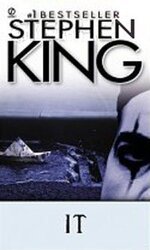
A promise made twenty-eight years ago calls seven adults to reunite in Derry, Maine, where as teenagers they battled an evil creature that preyed on the city’s children. Unsure that their Losers Club had vanquished the creature all those years ago, the seven had vowed to return to Derry if IT should ever reappear. Now, children are being murdered again and their repressed memories of that summer return as they prepare to do battle with the monster lurking in Derry’s sewers once more.
Авторы: King Stephen Edwin
country that day and heard it all.
‘»Where the government sends the black boys is your problem, not mine,» Mueller tells Major Fuller. «My problem is where you’re letting them go on Friday and Saturday nights. If
they go on whooping it up downt own, there’s going to be trouble. We’ve got the Legion in this town, you know.»
‘»Well, but I am in a bit of a tight here, Mr Mueller,» he says. «I can’t let them drink over at the NCO Club. Not only is it against the regulations for the Negroes to drink with the whites, they couldn’t anyway. It’s an NCO club, don’t you see? Every one of those black boys is a bucky-tail private.
‘»That’s not my problem either. I simply trust you will take care of the matter. Responsibility accompanies rank.» And off he goes.
‘Well, Fuller solved the problem. The Derry Army Base was a damn big patch of land in those days, although there wasn’t a hell of a lot on it. Better than a hundred acres, all told. Going north, it ended right behind West Broadway, where a sort of greenbelt was planted. Where Memorial Park is now, that was where the Black Spot stood.
‘It was just an old requisition shed in early 1930, when all of this happened, but Major Fuller mustered in Company E and told us it was going to be «our» club. Acted like he was Daddy Warbucks or something, and maybe he even felt that way, giving a bunch of black privates their own place, even if it was nothing but a shed. Then he added, like it was nothing, that the pigs downtown were off-limits to us.
‘There was a lot of bitterness about it, but what could we do? We had no real power. It was this young fellow, a Pfc. named Dick Hallorann who was a mess-cook, who suggested that maybe we could fix it up pretty nice if we really tried.
‘So we did. We really tried. And we made out pretty well, all things considered. The first time a bunch of us went in there to look it over, we were pretty depressed. It was dark and smelly, full of old tools and boxes of papers that had gone moldy. There was only two little windows and no lectricity. The floor was dirt. Carl Roone laughed in a kind of bitter way, I remember that, and said, «The ole Maje, he a real prince, ain’t he? Give us our own club. Sho!»
‘And George Brannock, who was also killed in the fire that fall, he said: «Yeah, it’s a hell of a black spot, all right.» And the name just stuck.
‘Hallorann got us going, though . . . Hallorann and Carl and me. I guess God will forgive us for what we did, though — cause He knows we had no idea how it would turn out.
‘After awhile the rest of the fellows pitched in. With most of Derry off-limits, there wasn’t much else we could do. We hammered and nailed and cleaned. Trev Dawson was a pretty good jackleg carpenter, and he showed us how to cut some more windows along the side, and damned if Alan Snopes didn’t come up with panes of glass for them that were different colors — sort of a cross between carnival glass and the sort you see in church windows.
‘»Where’d you get this?» I asked him. Alan was the oldest of us; he was about forty-two, old enough so that most of us called him Pop Snopes.
‘He stuck a Camel in his mouth and tipped me a wink. «Midnight Requisitions,» he says, and would say no more.
‘So the place come along pretty good, and by the middle of the summer we was using it. Trev Dawson and some of the others had partitioned off the back quarter of the building and got a little kitchen set up in there, not much more than a grill and a couple of deep-fryers, so that you could get a hamburg a nd some french fries, if you wanted. There was a bar down one side, but it was just meant for sodas and drinks like Virgin Marys — shit, we knew our place. Hadn’t we been taught it? If we wanted to drink hard, we’d do it in the dark.
‘The floor was still dirt, but we kept it oiled down nice. Trev and Pop Snopes ran in a lectric line — more Midnight Requisitions, I imagine. By July, you could go in there any Saturday night and sit down and have a cola and a hamburger — or a slaw-dog. It was nice. It never really got finished — we was still working on it when the fire burned it down. It got to be a kind of hobby . . . or a way of thumbing our noses at Fuller and Mueller and the Town
Council. But I guess we knew it was ours when Ev McCaslin and I put up a sign one Friday night that said THE BLACK SPOT, and just below that, COMPANY E AND GUESTS. Like we were exclusive, you know!
‘It got looking nice enough that the white boys started to grumble about it, and next thing you know, the white boys’ NCO was looking finer than ever. They was adding on a special lounge and a little cafeteria. It was like they wanted to race. But that was one race that we didn’t want to run.’
My dad smiled at me from his hospital bed.
‘We were young, except for Snopesy, but we weren’t entirely foolish. We knew that the white boys