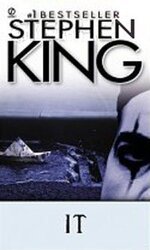
A promise made twenty-eight years ago calls seven adults to reunite in Derry, Maine, where as teenagers they battled an evil creature that preyed on the city’s children. Unsure that their Losers Club had vanquished the creature all those years ago, the seven had vowed to return to Derry if IT should ever reappear. Now, children are being murdered again and their repressed memories of that summer return as they prepare to do battle with the monster lurking in Derry’s sewers once more.
Авторы: King Stephen Edwin
let you race against them, but if it starts to look like you are getting ahead, why, somebody just breaks your legs so you can’t run as fast. We had what we wanted, and that was enough. But then . . . something happened.’ He fell silent, frowning.
‘What was that, Daddy?’
‘We found out that we had a pretty decent jazz-band among us,’ he said slowly. ‘Martin Devereaux, who was a corporal, played drums. Ace Stevenson played cornet. Pop Snopes played a pretty decent barrelhouse piano. He wasn’t great, but he wasn’t no slouch, either. There was another fellow who played clarinet, and George Brannock played the saxophone. There were others of us who sat in from time to time, playing guitar or harmonica or juiceharp or even just a comb with waxed paper over it.
‘This didn’t all happen at once, you understand, but by the end of that August, there was a pretty hot little Dixieland combo playing Friday and Saturday nights at the Black Spot. They got better and better as the fall drew on, and while they were never great — I don’t want to give you that idea — they played in a way that was different . . . hotter somehow . . . it . . . ‘ He waved his skinny hand above the bedclothes.
‘They played bodacious,’ I suggested, grinning.
‘That’s right!’ he exclaimed, grinning back. ‘You got it! They played bodacious Dixieland. And the next thing you know, people from town started to show up at our club. Even some of the white soldiers from the base. It got so the place was getting crowded a right smart every weekend. That didn’t happen all at once, either. At first those white faces looked like sprinkles of salt in a pepper-pot, but more and more of them turned up as time went on.
‘When those white people showed up, that’s when we forgot to be careful. They were bringin in their own booze in brown bags, most of it the finest high-tension stuff there is — made the stuff you could get in the pigs downtown look like soda pop. Country-club booze is what I mean, Mikey. Rich people’s booze. Chivas. Glenfiddich. The kind of champagne they served to first-class passengers on ocean liners. «Champers,» some of em called it, same as we used to call ugly-minded mules back home. We should have found a way to stop it, but we didn’t know how. They was town! Hell, they was white!
‘And, like I said, we were young and proud of what we’d done. And we underestimated how bad things might get. We all knew that Mueller and his friends must have known what was going on, but I don’t think any of us realized that it was drivin em crazy — and I mean what I say: crazy. There they were in their grand old Victorian houses on West Broadway not a quarter of a mile away from where we were, listening to things like «Aunt Hagar’s Blues» and «Diggin My Potatoes.» That was bad. Knowing that their young people were there too, whooping it up right cheek by jowl with the blacks, that must have been ever so much worse. Because it wasn’t just the lumberjacks and the barbags that were turning up as September came into October. It got to be kind of a thing in town. Young folks would come to drink and to dance to that no-name jazz-band until one in the morning came and shut us down. They didn’t just come from Derry, either. They come from Bangor a nd Newport and Haven and Cleaves Mills and Old Town and all the little burgs around these parts. You could see fraternity boys from the University of Maine at Orono cutting capers with their sorority
girlfriends, and when the band learned how to play a ragtime version of’ ‘The Maine Stein Song,» they just about ripped the roof off. Of course, it was an enlisted-men’s club — technically, at least — and off-limits to civilians who didn’t have an invitation. But in fact, Mikey, we just opened the door at seven and let her stand open until one. By the middle of October it got so that any time you went out on the dancefloor you were standing hip to hip with six other people. There wasn’t no room to dance, so you had to just sort of stand there and wiggle . . . but if anyone minded, I never heard him let on. By midnight it was like an empty freight –car rocking and reeling on an express run.’
He paused, took another drink of water, and then went on. His eyes were bright now.
‘Well, well. Fuller would have put an end to it sooner or later. If it had been sooner, a lot less people would have died. All you had to do was send in MPs and have them confiscate all the bottles of liquor that people had brought in with them. That would have been good enough — just what he wanted, in fact. It would have shut us down good and proper. There would have been court-martials and the stockade in Rye for some of us and transfers for all the rest. But Fuller was slow. I think he was afraid of the same thing some of us was afraid of — that some of the townies would be mad.