
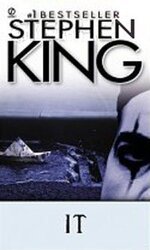
A promise made twenty-eight years ago calls seven adults to reunite in Derry, Maine, where as teenagers they battled an evil creature that preyed on the city’s children. Unsure that their Losers Club had vanquished the creature all those years ago, the seven had vowed to return to Derry if IT should ever reappear. Now, children are being murdered again and their repressed memories of that summer return as they prepare to do battle with the monster lurking in Derry’s sewers once more.
Авторы: King Stephen Edwin
— but there’s some kind of big mixup about who owns the land now. I guess he’ll get it eventually — he’s a persistent fella — but right now it’s in the courts.’
‘And the Canal,’ Bill murmured as they turned off Outer Center Street and onto Pasture Road — which, as Mike had said, was now marked with a green roadsign reading MALL ROAD. ‘The Canal’s still here.’
‘Ayup,’ the cabbie said. ‘That’ll always be here, I guess.’
Now the Derry Mall was on Bill’s left, and as they rolled past it, he felt that queer doubling sensation again. When they had been kids all of this had been a great long field full of rank grasses and gigantic nodding sunflowers which marked the northeastern end of the Barrens. Behind it, to the west, was the Old Cape low-income housing development. He could remember them exploring this field, being careful not to fall into the gaping cellarhold of the Kitchener Ironworks, which had exploded on Easter Sunday in the year 1906. The field had been full of relics and they had unearthed them with all the solemn interest of archaeologists exploring Egyptian ruins: bricks, dippers, chunks of iron with rusty bolts hanging from them, panes of glass, bottles full of unnamable gunk that smelled like the worst poison in the world.
Something bad had happened near here, too, in the gravel-pit close to the dump, but he could not remember it yet. He could only remember a name, Patrick Humboldt, and that it had something to do with a refrigerator. And something about a bird that had chased Mike Hanlon. What . . . ?
He shook his head. Fragments. Straws in the wind. That was all.
The field was gone now, as were the remains of the Ironworks. Bill remembered the great chimney of the Ironworks suddenly. Faced with tile, caked black with soot for the final ten feet of its length, it had lain in the high grass like a gigantic pipe. They had scrambled up somehow and had walked along it, arms held out like tightwire walkers, laughing — He shook his head, as if to dismiss the mirage of the mall, an ugly collection of buildings with signs that said SEARS and J. C. PENNEY and WOOLWORTH ‘s and C V S and YORK ‘S STEAK HOUSE and WALDENBOOKS and dozens of others. Roads wove in and out of parking lots. The mall did not go away, because it was no mirage. The Kitchener Ironworks was gone, and the field that had grown up around its rums was likewise gone. The mall was the reality, not the memories.
But somehow he didn’t believe that.
‘Here you go, mister,’ the cabbie said. He pulled into the parking-lot of a build ing that looked like a large plastic pagoda. ‘A little late, but better late than never, am I right?’
‘Indeed you are,’ Bill said. He gave the cab-driver a five. ‘Keep the change.’
‘Good fucking deal!’ the cabbie exclaimed. ‘You need someone to driv e y o u , c a l l B i g Yellow and ask for Dave. Ask for me by name.’
‘I’ll just ask for the religious fella,’ Bill said, grinning. ‘The one who’s got his plot all picked out in Mount Hope.’
‘You got it,’ Dave said, laughing. ‘Have a good one, mister.’
‘You too, Dave.’
He stood in the light rain for a moment, watching the cab draw away. He realized that he had meant to ask the driver one more question, and had forgotten — perhaps on purpose.
He had meant to ask Dave if he liked living in Derry.
Abruptly, Bill Denbrough turned and walked into the Jade of the Orient. Mike Hanlon was in the lobby, sitting in a wicker chair with a huge flaring back. He got to his feet, and Bill felt deep unreality wash over him — through him. That sensation of doubling was back, but now it was much, much worse.
He remembered a boy who had been about five feet three, trim, and agile. Before him was a man who stood about five-seven. He was skinny. His clothes seemed to hang on him. And the lines in his face said that he was on the darker side of forty instead of only thirty-eight or so.
Bill’s shock must have shown on his face, because Mike said quietly: ‘I know how I look.’
Bill flushed and said, ‘It’s not that bad, Mike, it’s just that I remember you as a kid. That’s all it is.’
‘Is it?’
‘You look a little tired.’
‘I am a little tired,’ Mike said, ‘but I’ll make it. I guess.’ He smiled then, and the smile lit his face. In it Bill saw the boy he had known twenty-seven years ago. As the old woodframe Home Hospital had been overwhelmed with modern glass and cinderblock, so had the boy that Bill had known been overwhelmed with the inevitable accessories of adulthood. There were wrinkles on his forehead, lines had grooved themselves from the comers of his mouth nearly to his chin, and his hair was graying on both sides above the ears. But as the old hospital, although overwhelmed, was still there, still visible, so was the boy Bill had known.
Mike