
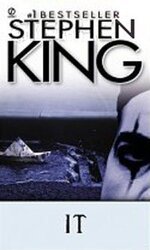
A promise made twenty-eight years ago calls seven adults to reunite in Derry, Maine, where as teenagers they battled an evil creature that preyed on the city’s children. Unsure that their Losers Club had vanquished the creature all those years ago, the seven had vowed to return to Derry if IT should ever reappear. Now, children are being murdered again and their repressed memories of that summer return as they prepare to do battle with the monster lurking in Derry’s sewers once more.
Авторы: King Stephen Edwin
it. He remembered that the day after he had seen the mummy on the iced-up Canal, his life had gone on as usual. He had known that whatever it had been had come very close to getting him, but his life had gone on: he had attended school, taken an arithmetic test, visited the library when school was over, and eaten with his usual heartiness. He had simply incorporated the thing he had seen on the Canal into his life, and if he had almost been killed by it . . . well, kids were always almost getting killed. They dashed across streets without looking, they got horsing around in the lake and suddenly realized they had floated far past their depth on their rubber rafts and had to paddle back, they fell off monkey-bars on their asses and out of trees on their heads.
Now, standing here in the fading drizzle in front of a Trustworthy Hardware Store that had been a pawnshop in 1958 (Frati Brothers, Ben recalled, the double windows always full of pistols and rifles and straight-razors and guitars hung up by their necks like exotic animals), ti occurred to him that kids were better at almost dying, and they were also better at incorporating the inexplicable into their lives. They believed implicitly in the invisible world. Miracles both bright and dark were to be taken into consideration, oh yes, most certainly, but they by no means stopped the world. A sudden upheaval of beauty or terror at ten did not preclude an extra cheese-dog or two for lunch at noon.
But when you grew up, all that changed. You no longer lay awake in your bed, sure something was crouching in the closet or scratching at the window . . . but when something did happen, something beyond rational explanation, the circuits overloaded. The axons and dendrites got hot. You started to jitter and jive, you started to shake rattle and roll, your imagination started to hop and bop and do the funky chicken all over your nerves. You couldn’t just incorporate what had happened into your life experience. It didn’t digest. Your mind kept coming back to it, pawing it lightly like a kitten with a ball of string . . . until eventually, of course, you either went crazy or got to a place where it was impossible for you to function.
And if that happens, Ben thought, It’s got me. Us. Cold.
He started to walk up Kansas Street, not conscious of heading anyplace in particular. And thought suddenly: What did we do with the silver dollar?
He still couldn’t remember.
The silver dollar, Ben . . . Beverly saved your life with it. Yours . . . maybe all the others’ . . . and especially Bill’s. It almost ripped my guts out before Beverly did . . . what? What did she do? And how was it able to work? She backed it off, and we all helped her. But how?
A word came to him suddenly, a word that meant nothing at all but which tightened his flesh: Chüd.
He looked down at the sidewalk and for a moment saw the shape of a turtle chalked there, and the world seemed to swim before his eyes. He shut them tightly and when he opened them saw it was not a turtle; only a hopscotch grid half-erased by the light rain.
Chüd.
What did that mean?
‘I don’t know,’ he said aloud, and when he looked around quickly to see if anyone had heard him talking to himself, he saw that he had turned off Kansas Street and onto Costello Avenue. At lunch he had told the others that the Barrens were the only place in Derry where he had felt happy as a kid . . . but that wasn’t quite true, was it? There had been another place. Either accidentally or unconsciously, he had come to that other place: the Derry Public Lib rary.
He stood in front of it for a minute or two, hands still in his pockets. It hadn’t changed; he admired its lines as much now as he had as a child. Like so many stone buildings that had been well-designed, it succeeded in confounding the closely observing eye with contradictions: its stone solidity was somehow balanced by the delicacy of its arches and slim columns; it looked both bank –safe squat and yet slim and clean (well, it was slim as city buildings went, especially those erected around the turn of the century, and the windows, crisscrossed with narrow strips of iron, were graceful and rounded). These contradictions saved it from ugliness, and he was not entirely surprised to feel