
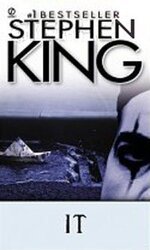
A promise made twenty-eight years ago calls seven adults to reunite in Derry, Maine, where as teenagers they battled an evil creature that preyed on the city’s children. Unsure that their Losers Club had vanquished the creature all those years ago, the seven had vowed to return to Derry if IT should ever reappear. Now, children are being murdered again and their repressed memories of that summer return as they prepare to do battle with the monster lurking in Derry’s sewers once more.
Авторы: King Stephen Edwin
(like he was on his way to somewhere else) Eddie would sometimes hear the click of the balls, laughter, groans as someone’s ball was ‘sent away.’ Once he had seen Greta herself, a lemonade in one hand and her croquet mallet in the other, looking slim and pretty beyond the words of all the poets (even her sunburned shoulders seemed wonderfully pretty to Eddie Kaspbrak, who had at that time been nine), going after her ball, which had been ‘sent away’; it had ricocheted off a tree and had thus brought Greta into Eddie’s view.
He fell in love with her a little that day — her shining blonde hair falling to the shoulders of her culotte dress, which was a cool blue. She glanced around and for a moment he thought she had seen him, but that proved not to be so, because when he raised his hand in a timid hello, she did not raise hers in return but only whacked her ball back onto the rear lawn and then ran after it. He had walked on with no resentment at the unreturned hello (he genuinely believed she must not have see him) or at the fact that he had never been invited to attend one of the Saturday-aft ernoon croquet games: why would a beautiful girl like Greta Bowie want to invite a kid like him? He was thin-chested, asthmatic, and had the face of a drowned water-rat.
Yeah, he thought, walking aimlessly back down Kansas Street, I should have gone over toWest Broadway and looked at all those houses again . . . the Muellers’, the Bowies’, Dr Hole’s place, the Trackers’ —
His thoughts broke off abruptly at that last name, because — speak of the devil! — here he was, standing in front of Tracker Brothers’ Truck Depot.
‘Still right here,’ Eddie said aloud, and laughed. ‘Son of a gun!’
The house on West Broadway which belonged to Phil and Tony Tracker, a pair of life-long bachelors, was probably the loveliest of the large houses on that street, a spotlessly white mid –Victorian with green lawns and great beds of flowers that rioted (in a neatly landscaped way, of course) all the spring and summer long. Their driveway was freshly sealed each fall so that it always remained as black as a dark mirror, the slate shingles on the many slants of the roof were always a perfect mint green that almost exactly matched the lawn, and people sometimes stopped to take pictures of the mullioned windows, which were very old and quite remarkable.
‘ A n y t w o m e n who bother keeping a house so nice must be queers,’ Eddie’s mother had once said in a disgruntled sort of way, and Eddie hadn’t dared ask for clarification.
The Truck Depot was the exact opposite of the Tracker house on West Broadway. It was a low bric k structure; the bricks were old and crumbling in places, their dirty-orange hue shading to a sooty black at the building’s footings. The windows were uniformly filthy except for a small circular place on one of the lower panes of the starter’s office. This one pane had been kept spotlessly clean by kids before Eddie and those who came after, because the starter kept a Playboy calendar over his desk. No boy came to play scratch baseball in the back lot without first stopping to wipe at the glass with his ball-glove and examine that month’s pinup.
The depot was surrounded by a waste of gravel on three sides. Long-distance haulers — Jimmy-Petes and Kenworths and Rios — all painted with the words TRACKER BROS. DERRY NEWTON PROVIDENCE HARTFORD NEW YORK, some times stood here in tangled disordered profusion. Sometimes they were put together and sometimes there were just cabs or body-boxes, standing silent on their rear wheels and support-struts.
The brothers kept their trucks out of the lot at the back of th e building as much as they could, because they were both avid baseball fans and liked the kids to come and play. Phil Tracker drove freight himself so the boys rarely saw him, but Tony Tracker, a man with huge slab arms and a gut to match, kept the books and the accounts, and Eddie (who never played
— his mother would have killed him if she had heard he was playing baseball, racing around and getting dust in his delicate lungs, risking broken legs, concussions, and God alone knew what else) got used to seeing him. He was a summer fixture, his voice as much a part of the game to Eddie then as Mel Alien’s later became: Tony Tracker, large but somehow ghostlike, his white shirt glimmering as summer dusk drew down and fireflies began to loom the air with their lace of lights, yelling: ‘You got to get under that bawl before you can catch it, Red! . . . You took your eye off ‘n the bawl, Half-Pint! You can’t hit the goddam thing if you ain’t looking at it! . . . Slide, Horsefoot! You get the soles of them Keds in that second-baseman’s face, he ain’t