
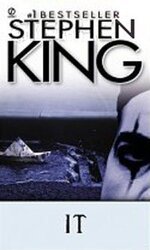
A promise made twenty-eight years ago calls seven adults to reunite in Derry, Maine, where as teenagers they battled an evil creature that preyed on the city’s children. Unsure that their Losers Club had vanquished the creature all those years ago, the seven had vowed to return to Derry if IT should ever reappear. Now, children are being murdered again and their repressed memories of that summer return as they prepare to do battle with the monster lurking in Derry’s sewers once more.
Авторы: King Stephen Edwin
it.
‘You could and you will,’ Mrs Kersh said warmly. ‘It’s the least I can do for having told you such unpleasant news.’
Before she could protest, Beverly found herself being led up the gloomy hall and into her old apartment, which now seemed much smaller but safe enough — safe, she supposed, because almost everything was different. Instead of the pink-topped Formica table with its three chairs, there was a small round table, really not much bigger than an endtable, with silk flowers in a pottery vase. Instead of the old Kelvinator refrigerator with the round drum on top (her father tinkered with it constantly to keep it going), there was a copper-colored Frigidaire. The stove was small but efficient-looking. There was an Amana Radar Range above it. Bright blue curtains hung in the windows, and she could see flowerboxes outside them. The floor, linoleum when she was a girl here, had been stripped to its original wood. Many applications of oil made it glow mellowly.
Mrs Kersh looked around from the stove, where she was placing a teapot. ‘You grew up here?’
‘Yes,’ Beverly said. ‘But it’s very different now . . . so trim and tidy . . . wonderful!’
‘How kind you are,’ Mrs Kersh said, and her smile made her younger. It was radiant. ‘I have a little money, you see. Not much, but with my Social Security I am comfortable. Once I was a girl in Sweden. I came to this country in 1920, a girl of fourteen with no money — which is the best way to learn the value of money, would you agree?’
‘Yes,’ Bev said.
‘At the hospital I worked,’ Mrs Kersh said. ‘Many years — from 1925 I worked there. I rose to the position of head housekeeper. All the keys I had. My husband invested our money quite well. Now I have reached a little harbor. Look around, miss, while the water boils!’
‘No, I couldn’t — ‘
‘Please . . . still I feel guilty. Look, if you like!’
And so she did look. Her parents’ bedroom was now Mrs Kersh’s bedroom, and the difference was profound. The room seemed brighter and airier now. A large cedar chest, the initials RG inlaid into it, breathed its gentle aroma into the air. A gigantic surprise-quilt lay on the bed. On it she could see women drawing water, boys driving cattle, men building haystacks. A wonderful quilt.
Her room had become a sewing room. A black Singer machine stood on a wrought-iron table under a pair of starkly efficient Tensor lamps. A picture of Jesus hung on one wall, a picture of John F. Kennedy on another. A beautiful breakfront stood below the picture of JFK — it was filled with books ins tead of china, but seemed none the worse for that.
She went into the bathroom last.
It had been redone in a rose color that was too low and pleasant to seem gaudy. All of the fixtures were new, and yet she approached the basin feeling that the old nightmare had gripped her again; she would peer down into that black and lidless eye, the whispering would begin, and then the blood —
She leaned over the sink, catching a glimpse of her pallid face and dark eyes in the mirror over the basin, and then she stared into that eye, waiting for the voices, the laughter, the groans, the blood.
How long might she have stood there, bent over the sink, waiting for the sights and sounds twenty-seven years gone, she didn’t know; it was Mrs Kersh’s voice that bi d her return: ‘Tea, miss!’
She jerked back, the semi-hypnosis broken, and left the bathroom. If there had been dark magic somewhere down in that drain, it was gone now . . . or was sleeping.
‘Oh, you shouldn’t have!’
Mrs Kersh looked up at her brightly, smiling a little. ‘O miss, if you knew how seldom company calls these days, you’d not say so. Why, I put on more than this for the man from the Bangor Hydro who comes to read my meter! I’m making him fat!’
Delicate cups and saucers stood on the round kitchen table, a clean bone-white edged with blue. There was a plate of small cakes and cookies. Beside the sweets a pewter teapot chuffed mild steam and pleasant fragrance. Bemused, Bev thought that the only things missing were the tiny sandwiches with the crusts cut off: auntsandwiches, she’d thought them, always one word. Three main types of auntsandwiches — cream cheese and olive, watercress, and egg salad.
‘Sit down,’ said Mrs Kersh. ‘Sit down, miss, and I’ll pour out.’
‘I’m not a mis s,’ Beverly said, and raised her left hand so that her ring would show.
Mrs Kersh smiled and pushed a hand through the air — pshaw! the gesture said. ‘I call all the pretty young girls miss,’ she said. ‘Just a habit. Don’t take offense.’
‘No,’ Beve rly said, ‘not at all.’ But for some reason she felt a feather-touch of unease: there was something in the old woman’s smile that had seemed a little . . . what? Unpleasant? False?