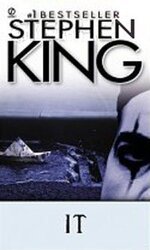
A promise made twenty-eight years ago calls seven adults to reunite in Derry, Maine, where as teenagers they battled an evil creature that preyed on the city’s children. Unsure that their Losers Club had vanquished the creature all those years ago, the seven had vowed to return to Derry if IT should ever reappear. Now, children are being murdered again and their repressed memories of that summer return as they prepare to do battle with the monster lurking in Derry’s sewers once more.
Авторы: King Stephen Edwin
Boston at night, when the air had thinned and the hoarse enthusiastic voice of Arnie Ginsberg came wavering in and out like the voice of a ghost called up at a seance. The beat did more than make him happy. It made him feel bigger, stronger, more there. When Frankie Ford sang ‘Sea Cruise’ or Eddie Cochran sang ‘Summertime Blues,’ Richie was actually transported with joy. There was power in that music, a power which seemed to most rightfully belong to all the skinny kids, fat kids, ugly kids, shy kids — the world’s losers, in short. In it he felt a mad hilarious voltage which had the power to both kill and exalt. He idolized Fats Domino (who made even Ben Hanscom look sum and trim) and Buddy Holly, who, like Richie, wore glasses, and Screaming Jay Hawkins, who popped out of a coffin at his concerts (or so Richie had been told), and the Dovells, who danced as good as black guys.
Well, almost.
He would have his rock and roll someday if he wanted it — he was confident it would still be there for him when his mother finally gave in and let him have it — but that would not be on March 28th, 1958 . . . or in 1959 . . . or . . .
His eyes had drifted away from the marquee and then . . . well . . . then he must have fallen asleep. It was the only explanation that made sense. What had happened next could only happen in dreams.
And now here he was again a Richie Tozier who had finally gotten all the rock and roll he had ever wanted . . . and who had found, happily, that it still wasn’t enough. His eyes went to the marquee in front of City Center and saw that, with a hideous kind of serendipity, those same blue letters spelled out:
JUNE 14TH
HEAVY METAL MANIA!
JUDAS PRIEST
IRON MAIDEN
BUY YOUR TICKETS HERE OR AT ANY TICKETRON OUTLET
Somewhere along the way they dropped the wholesome entertainment line, thought Richie, but as far as I can tell that’s just about the only difference,
And heard Danny and the Juniors, dim and distant, like voices heard down a long corridor coming out of a cheap radio: Rock and roll will never die, I’ll dig it to the end . . . It’ll go down in history, just you watch my friend . . .
Richie looked back at Paul Bunyan, patron saint of Derry — Derry, which had come into being, according to the stories, because this was where the logs fetched up when they came downriver. There had been a time when, in the spring, both the Penobscot and the Kenduskeag would have been solid logs from one side to the other, their black bark hides glistening in the spring sun. A fellow who was fast on his feet could walk from Wally’s Spa in Hell’s Half-Acre over to Ramper’s in Brewster (Ramper’s was a tavern of such horrible repute that it was commonly called the Bucket of Blood) without getting his boots wet over the third crossing of his rawhide laces. Or so it had been storied in Richie’s youth, and he supposed there was a bit of Paul Bunyan in all such stories.
Old Paul, he thought, looking up at the plastic statue. What you been doing since I’ve beengone? Made any new riverbeds coming home tired and dragging your axe behind you? Made any new lakes on account of wanting a bathtub big enough so you could sit in water up to your neck? Scared any more little kids the way you scared me that day?
Ah, and suddenly he remembered it all, the way you will sometimes suddenly remember a word which has been dancing on the tip of your tongue.
There he had been, sitting in that mellow March sunshine, drowsing a little, thinking about going home and catching the last half hour of Bandstand, and suddenly there had been a warm swash of air into his face. It blew his hair back from his forehead. He looked up and Paul Bunyan’s huge plastic face had been right in front of his, bigger than a face on a movie screen, filling everything. The rush of air had been caused by Paul bending down . . . although he did not precisely look like Paul anymore. The forehead was now low and beetling; tufts of wiry hair poked from a nose as red as the nose of a long-time drunkard; his eyes were bloodshot and one had a slight cast to it.
The axe was no longer on his shoulder.