
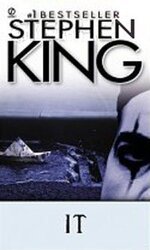
A promise made twenty-eight years ago calls seven adults to reunite in Derry, Maine, where as teenagers they battled an evil creature that preyed on the city’s children. Unsure that their Losers Club had vanquished the creature all those years ago, the seven had vowed to return to Derry if IT should ever reappear. Now, children are being murdered again and their repressed memories of that summer return as they prepare to do battle with the monster lurking in Derry’s sewers once more.
Авторы: King Stephen Edwin
of the past folding in on itself, folding in on him. He hadn’t meant to ask that little girl anything; the question had popped out of his mouth like a cork flying from the neck of a champagne bottle.
He descended Up-Mile Hill toward downtown. The warehouses and packing plants he remembered from childhood — gloomy brick buildings with duty windows from which titanic meaty smells issued — were mostly gone, although the Armour and the Star Beef meat-packing plants were still there. But Hemphill was gone and there was a drive –in bank and a bakery where Eagle Beef and Kosher Meats had been. And there, where the Tracker Brothers’ Annex had stood, was a sign painted in oldfashioned letters which read, just as the girl with the doll had said, SECONDHAND ROSE, SECONDHAND CLOTHES . The red brick ha d been painted a yellow which had perhaps been jaunty ten or twelve years ago, but was now dingy — a color Audra called urine –yellow.
Bill walked slowly toward it, feeling that sense of déjà vu settle over nun again. Later he told the others he knew what ghost he was going to see before he actually saw it.
The show-window of Secondhand Rose, Secondhand Clothes was more than dingy; it was filthy. No Downcast antique shop this, with nifty little spool-beds and Hoosier cabinets and sets of Depression glassware highlighted by hidden spotlights; this was what his mother called with utter disdain ‘a Yankee pawnshop.’ The items were strewn in rickrack profusion, heaped aimlessly here, there, and everywhere. Dresses slumped off coathangers. Guitars hung from their necks like executed criminals. There was a box of 45 rpm records — 10 c APIECE,
the sign read. TWELVE FOR A BUCK. ANDREWS SISTERS, PERRY COMO, JIMMY ROGERS, OTHERS. There were kids’ outfits and dreadful-looking shoes with a card in front of them which read SECONDS, BUT NOT BAD! $1.00 A PAIR. There were two TVs that looked blind. A third was casting bleared images of The Brady Bunch out toward the street. A box of old paperbacks, most with stripped covers (2 FOR A QUARTER, 10 FOR A DOLLAR, more inside , SOME ‘HOT’) sat atop a large radio with a filthy white plastic case and a tuning dial as big as an alarm clock. Bunches of plastic flowers sat in dirty vases on a chipped, gouged, dusty dining-room table.
All of these things Bill saw as a chaotic background to the thing his eyes had fixed upon immediately. He stood staring at it with wide unbelieving eyes. Gooseflesh ran madly up and down his body. His forehead was hot, his hands cold, and for a moment it seemed that all the doors inside would swing wide and he would remember everything.
Silver was in the righthand window.
His kickstand was still gone and rust had flowered on the front and back fenders, but the oogah-horn was still there on the handlebars, its rubber bulb now glazed with cracks and age. The horn itself, which Bill had always kept neatly polished, was dull and pitted. The flat package carrier where Richie had often ridden double was still on the back fender, but it was bent now, hanging by a single bolt. At some point someone had covered the seat with imitation tiger-skin which was now rubbed and frayed to a point where the stripes were almost indistinguishable.
Silver.
Bill raised an absent hand to wipe away the tears that were running slowly down his cheeks. After he had done a better job with his handkerchief, he went inside.
The atmosphere of Secondhand Rose, Secondhand Clothes was musty with age. It was, as the girl had said, a attic smell — but not a good smell, as some attic smells are. This was not the smell of linseed oil rubbed lovingly into the surface of old tables or of ancient plush and velvet. In here was a smell of rotting book-bindings, dirty vinyl cushions that had been half-cooked in the hot suns of summers past, dust, mouse-turds.
From the TV in th e window the Brady Bunch cackled and whooped. Competing with them from somewhere in the back was the radio voice of a disc jockey identifying himself as ‘your pal Bobby Russell’ promising the new album by Prince to the caller who could give the name of the actor who had played Wally on Leave It to Beaver. Bill knew — it had been a kid named Tony Dow — but he didn’t want the new Prince album. The radio was sitting on a high shelf amid a number of nineteenth-century portraits. Below it and them sat the proprietor, a man of perhaps forty who was wearing designer jeans and a fishnet tee-shirt. His hair was slicked back and he was thin to the point of emaciation. His feet were cocked up on his desk, which was piled high with ledgers and dominated by an old scrolled cash register. He was reading a paperback novel which Bill thought had never been nominated for the Pulitzer Prize.