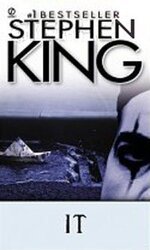
A promise made twenty-eight years ago calls seven adults to reunite in Derry, Maine, where as teenagers they battled an evil creature that preyed on the city’s children. Unsure that their Losers Club had vanquished the creature all those years ago, the seven had vowed to return to Derry if IT should ever reappear. Now, children are being murdered again and their repressed memories of that summer return as they prepare to do battle with the monster lurking in Derry’s sewers once more.
Авторы: King Stephen Edwin
they looked around, Bill would remember years later, as if for someone who wasn’t there.
‘Who?’ Stan asked doubtfully. ‘I can’t think of anyone else I trust.’
‘Just the suh-suh –same . . . ‘ Bill said in a troubled voice, and a little silence fell among them while Bill thought about what to say next.
3
If asked, Ben Hanscom would have told you that Henry Bowers hated him more than any of the others in the Losers’ Club, because of what had happened that day when he and Henry had shot the chutes down into the Barrens from Kansas Street, because of what had happened the day he and Richie and Beverly escaped from the Aladdin, but most of all because, by not allowing Henry to copy during examinations, he had caused Henry to be sent to summerschool and incur the wrath of his father, the reputedly insane Butch Bowers.
If asked, Richie Tozier would have told you Henry hated him more than any of the others, because of the day he had fooled Henry and his two other musketeers in Freese’s.
Stan Uris would have told you that Henry hated him most of all because he was a Jew (when Stan had been in the third grade and Henry the fifth, Henry had once washed Stan’s face with snow until it bled and he was screaming hysterically with pain and fear).
Bill Denbrough believed that Henry hated him the most because he was skinny, because he stuttered, and because he liked to dress well (‘L-L-Look at the f-f-f-fucking puh-puh-PANSY! ‘ Henry had cried when the Derry School had had Careers Day in April and Bill had come
wearing a tie; before the day was over, the tie had been ripped off and flung into a tree halfway down Charter Street).
He did hate all four of them, but the boy in Derry who was number one on Henry’s personal Hate Parade was not in the Losers’ Club at all on that July 3rd; he was a black boy named Michael Hanlon, who lived a quarter of a mile down the road from the shirttail Bowers farm.
Henry’s father, who was every bit as crazy as he was reputed to be, was Oscar ‘Butch’ Bowers. Butch Bowers associated his financial, physical, and mental decline with the Hanlon family in general and with Mike’s father in particular. Will Hanlon, he was fond of telling his few friends and his son, had had him thrown in the county jail when all of his, Hanlon’s, chickens died. ‘So’s he could get the insurance money, don’t you know,’ Butch would say, eying his audience with all the baleful interrupt-if-you-dare pugnacity of Captain Billy Bones in the Admiral Benbow. ‘He got some of his friends to lie him up, and that’s why I had to sell my Merc’ry.’
‘Who lied him up, Daddy?’ Henry had asked when he was eight, burning at the injustice that had been done to his father. He thought to himself that when he was a grownup he would find liar-uppers and coat them with honey and stake them out over anthills, like in some of those Western movies they showed at the Bijou Theater on Saturday afternoons.
And because his son was a tireless listener (although, if asked, Butch would have maintained that was only as it should be), Bowers Senior filled his son’s ears with a litany of hate and hard luck. He explained to his son that while all niggers were stupid, some were cunning as well — and down deep they all hated white men and wanted to plow a white woman’s furrow. Maybe it wasn’t just the insurance money after all, Butch said; maybe Hanlon had decided to lay the blame for the dead chickens at his door because Butch had the next produce stand down the road. He done it, anyway, and that was just as sure as shit sticks to a blanket. He done it and then got a bunch of white nigger bleeding hearts from town to lie him up and threaten Butch with state prison if he didn’t pay that nigger off. ‘And why not?’ Butch would ask his round-eyed dirty-necked silent son. ‘Why not? I was just a man who fought the Japs for his country. There was lots of guys like us, but he w a s t h e o n l y n i g g e r i n the county.’
The chicken business had been followed by one unlucky incident after another — his Deere tractor had blown a rod; his good harrow got busted in the north field; he got a boil on his neck which became infected, had to be lanced, then became infected again and had to be removed surgically; the nigger started using his foully gotten money to undercut Butch’s prices so they lost custom.
In Henry’s ears, it was a constant litany: the nigger, the nigger, the nigger. Everything was the nigger’s fault. The nigger had a nice white house with an upstairs and an oil furnace while Butch and his wife and his son lived in what was not much better than a tarpaper shack. When Butch couldn’t make enough money farming and had to go to work in the woods for awhile, it was the nigger’s fault. When their well