
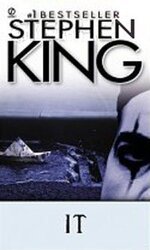
A promise made twenty-eight years ago calls seven adults to reunite in Derry, Maine, where as teenagers they battled an evil creature that preyed on the city’s children. Unsure that their Losers Club had vanquished the creature all those years ago, the seven had vowed to return to Derry if IT should ever reappear. Now, children are being murdered again and their repressed memories of that summer return as they prepare to do battle with the monster lurking in Derry’s sewers once more.
Авторы: King Stephen Edwin
Then Stanley Uris gripped his wrist firmly and brought him back to dead center.
‘Close call,’ Stan said. ‘If you fell in, your mother’d give you heck.’
Thoughts of his mother were, for once, the furthest things from Eddie’s mind. The others had gained the fa r bank now and were counting cars on the freight. Eddie stared wildly into Stan’s eyes, then looked into the water again. He saw a potato-chip bag go dancing by, but that was all. He looked up at Stan again.
‘Stan, I saw — ‘
— ‘What?’
Eddie shook his head. ‘Nothing, I guess,’ he said. ‘I’m just a little
(but they were there yes they were and they would have eaten me alive)
‘ — jumpy. The tiger, I guess. Keep going.’
This western bank of the Kenduskeag — the Old Cape bank — was a quagmire of mud during rainy weather and the spring runoff, but there had been no heavy rain in Derry for two weeks or more and the bank had dried to an alien crack-glaze from which several of those cement cylinders poked, casting grim little shadows. About twenty yards farther down, a cement pipe jutted out over the Kenduskeag and spilled a steady thin stream of foul-looking brown water into the river.
Ben said quietly, ‘It’s creepy here,’ and the others nodded.
Bill led them up the dry bank and back into the heavy shrubbery, where bugs whirred and chiggers chigged. Every now and then there would be a heavy ruffle of wings as a bird took off. Once a squirrel ran across their path, and about five minutes later, as they approached the low wrinkle of ridge that guarded the town dump’s blind side, a large rat with a bit of cellophane caught in its whiskers trundled in front of Bill, passing along its own secret run through its own microcosmic wilderness.
The smell of the dump was now clear and pungent; a black column of smoke rose in the sky. The ground, while still heavily overgrown except for their own narrow path, began to be strewn with litter. Bill had dubbed this ‘dump-dandruff,’ and Richie had been delighted; he had laughed almost until he cried. ‘You ought to write that down, Big Bill,’ he said. ‘That’s really good.’
Papers caught on branches wavered and flapped like cut-rate pennants; here was a silver gleam of summer sun reflected from a clutch of tin cans lying at the bottom of a green and tangled hollow; there the hotter reflection of sunrays bouncing off a broken beer bottle. Beverly spied a babydoll, its plastic skin so brightly pink it looked almost boiled. She picked it up, then dropped it with a little cry as she saw the whitish-gray beetles squirming from beneath its moldy skirt and down its rotting legs. She rubbed her fingers on her jeans.
They climbed to the top of the ridge and looked down into the dump.
‘Oh shit,’ Bill said, and jammed his hands into his pockets as ht e others gathered around him.
They were burning the northern end today, but here, at their end, the dumpkeeper (he was, in fact, Armando Fazio, Mandy to his friends, and the bachelor brother of the Derry Elementary School janitor) was tinkering on the World War II D– 9 ‘dozer he used to push the crap into piles for burning. His shirt was off, and the big portable radio sitting under the canvas parasol on the ‘dozer’s seat was putting out the Red Sox — Senators pregame festivities.
‘Can’t go down there,’ Ben agreed. Mandy Fazio was not a bad guy, but when he saw kids in the dump he ran them off at once — because of the rats, because of the poison he regularly sowed to keep the rat population down, because of the potential for cuts, falls, and burns . . . but mostly because he believed a dump was no place for children to be. ‘Ain’t you nice?’ he would yell at the kids he spied who had been drawn to the dump with their .22s to plink away at bottles (or rats, or seagulls) or by the exotic fascination of d’ ump –picking’: you might find a toy that still worked, a chair that could be mended for a clubhouse, or a junked TV with the picture-tube still intact — if you threw a rock through one of these there was a very satisfying explosion. ‘Ain’t you kids nice?’ Mandy would bellow (he bellowed not because he was angry but because he was deaf and wore no hearing-aid). ‘Dintchore folks teach you to be nice? Nice boys and girls don’t play in the dump! Go to the park! Go to the liberry! Go down to Community House and play box-hockey! Be nice! ‘
‘Nope,’ Richie said. ‘Guess the dump’s out.’
They all sat down for a few moments to watch Mandy work on his ‘dozer, hoping he would give up and go away but not really believing he would: the presence of the radio suggested Mandy intended to stay all afternoon. It was enough to piss off the Pope, Bill thought. There was really no better