
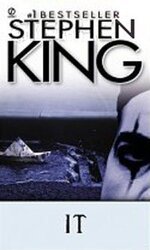
A promise made twenty-eight years ago calls seven adults to reunite in Derry, Maine, where as teenagers they battled an evil creature that preyed on the city’s children. Unsure that their Losers Club had vanquished the creature all those years ago, the seven had vowed to return to Derry if IT should ever reappear. Now, children are being murdered again and their repressed memories of that summer return as they prepare to do battle with the monster lurking in Derry’s sewers once more.
Авторы: King Stephen Edwin
had come. When she had entered the pines beyond the junked cars; she looked back over her shoulder. No one was there. The dump dozed in the sun. She felt the bands of tension around her chest and stomach loosen with relief, and all that was left was the need to urinate, so great that she now felt sick with it.
She hurried down the path a short way and then ducked off to the right. She had her shorts unsnapped almost before the underbrush had closed behind her again. She took a quick look around to make sure there was no poison ivy at hand; then she squatted, holding the tough trunk of a bush for balance.
She was pulling her shorts up again when she heard approaching footsteps from the dump. All she could see through the bushes were flashes of blue denim and the faded plaid of a school-shirt. It was Patrick. She ducked down, waiting for him to pass by toward Kansas Street. She was more sanguine about her position here. The cover was good, she no longer had to pee, and Patrick was off in his own cuckoo world. When he was gone she would double back and head for the clubhouse.
But Patrick didn’t pass by. He stopped on the path almost directly opposite her and stood looking at the rusting Amana refrigerator.
Beverly could observe Patrick along a natural sight– line in the bushes without too much chance of being seen. Now that she was relieved, she found she was curious again — a n d i f Patrick did happen to see her, she felt certain she could outrun him. He wasn’t as fat as Ben, but he was podgy. She pulled the Bullseye out of her back pocket, however, and put half a dozen steel pellets in the breast pocket of her old Ship ‘n Shore. Crazy or not, a good one to the knee might discourage the likes of Patrick Hockstetter in a hurry.
She remembered the refrigerator well enough now. There were lots of discarded fridges at the dump, but it suddenly occurred to her that this was the only one she’d seen which Mandy Fazio hadn’t disarmed by either tearing out the latching mechanism with pliers or simply removing the door altogether.
Patrick began to hum and sway back and forth in front of the rusty old refrigerator, and Beverly felt a fresh chill course through her. He was like a guy in a horror movie trying to summon a dead body out of a crypt.
What’s he up to?
But if she had known that, or what was going to happen when Patrick finished his private ritual and opened the dead Amana’s rusty door, she would have run away as fast as she could.
5
No one — not even Mike Hanlon — had the slightest idea of how crazy Patrick Hockstetter really was. He was twelve, the son of a paint salesman. His mother was a devout Catholic who would die of breast cancer in 1962, of ur years after Patrick was consumed by the dark entity which existed in and below Derry. Although his IQ tested out as low normal, Patrick had already repeated two grades, the first and third. He was taking summer classes this year so he would not have to repeat the fifth as well. His teachers found him an apathetic student (this several of them noted on the bare six lines of the Derry Elementary School’s report cards reserved for TEACHER’S COMMENTS) and a rather disturbing one as well (which none noted — their feelings were too vague, too diffuse, to be expressed in sixty lines, let alone six). If he had been born ten years later, a guidance counsellor might have steered him toward a child psychologist who might (or might not; Patrick was far more clever than his lackluster IQ results indicated) have realized the frightening depths behind that slack and pallid moonface.
He was a sociopath, and perhaps, by that hot July in 1958, he had become a full-fledged psychopath. He could not remember a time when he had believed that other people — a n y other living creatures, for that matter — were ‘real.’ He believed himself to be an actual creature, probably the only one in the universe, but was by no means convinced that his actuality made him ‘real.’ He had no sense of hurting, exactly, and no real sense of being hurt (his indifference to being struck in the mouth by Henry in the dump was a case in point). But while he found reality a totally meaningless concept, he understood the concept of ‘rules’ perfectly. And while all of his teachers had found him odd (both Mrs Douglas, his fifth-grade teacher, and Mrs Weems, who had had Patrick in the third grade, knew about the pencil-box full of flies, and while neither of them totally ignored the implications, each had between
twenty and twenty-eight other students, each with problems of his or her own), none of them had serious disciplinary problems with him. He might turn in test papers that were utterly blank — or blank except for a large, decorative question-mark — a nd Mrs Douglas had discovered