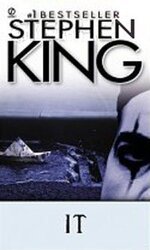
A promise made twenty-eight years ago calls seven adults to reunite in Derry, Maine, where as teenagers they battled an evil creature that preyed on the city’s children. Unsure that their Losers Club had vanquished the creature all those years ago, the seven had vowed to return to Derry if IT should ever reappear. Now, children are being murdered again and their repressed memories of that summer return as they prepare to do battle with the monster lurking in Derry’s sewers once more.
Авторы: King Stephen Edwin
and poured himself a glass of milk. His mother came down half an hour later and said she hadn’t even heard him come in, she had been that tired (you won’t be anymore, Mom, Patrick thought, don’t worry, I fixed it). She sat down with him, ate one of his cookies, and asked him how school had been. Patrick said it was all right and showed her his drawing of a house and a tree. His paper was covered with looping meaningless scribbles made with black and brown crayon. His mother said it was very nice. Patrick brought home the same looping scrawls of black and brown every day. Sometimes he said it was a turkey, sometimes a Christmas tree, sometimes a boy. His mother always told him it was very nice . . . although sometimes, in a part of her so deep she hardly knew it was there, she worried. There was something a little disquieting about the dark sameness of those big scribbled loops of black and brown.
She didn’t discover Avery’s death until nearly five o’clock; until then she had simply assumed he was taking a very long nap. By then Patrick was watch i n g Crusader Rabbit on their seven-inch TV, and he went on watching TV through all the uproar that followed. Whirlybirds was on when Mrs Henley arrived from next door (his screaming mother had been holding the baby’s corpse in the open kitchen door, believing in some blind way that the cold air might revive it; Patrick was cold and got a sweater out of the downstairs closet). HighwayPatrol, Ben Hanscom’s favorite, was on when Mr Hockstetter arrived home from work. By the time the doctor arrived, Science Fiction Theater, with Your Host Truman Bradley, was just coming on. ‘Who knows what strange things the universe may hold?’ Truman Bradley speculated while Patrick’s mother shrieked and struggled in her husband’s arms in the kitchen. The doctor observed Patrick’s deep calm and unquestioning stare and assumed the boy was in shock. He wanted Patrick to take a pill. Patrick didn’t mind.
It was diagnosed as crib –death. Years later there might have been questions about such a fatality, deviations from the usua l infant-death syndrome observed. But when it happened, the death was simply noted and the baby buried. Patrick was gratified that once things finally settled down his meals began to come on time again.
In the madness of that afternoon and evening — people banging in and out of the house, the red lights of the Home Hospital ambulance pulsing on the walls, Mrs Hockstetter screaming and wailing and refusing to be comforted — only Patrick’s father came within brushing distance of the truth. He was standing numbly by Avery’s empty crib some twenty minutes after the body had been removed, simply standing there, unable to believe any of this had happened. He looked down and saw a pair of tracks on the hardwood floor. They had been made by the snow melting off Patrick’s yellow rubber boots. He looked at them, and a dreadful thought rose briefly in his mind like bad gas from a deep mineshaft. His hand went slowly to his mouth and his eyes widened. A picture began to form in his mind. Before it could come clear he left the room, slamming the door behind him so hard that the top of the frame splintered.
He never asked Patrick any questions.
Patrick had never done anything like that again, although he might have done so if the chance had presented itself. He felt no guilt, had no bad dreams. As time passed, however, he became more aware of what would have happened to him if he had been caught. There were
rules. Unpleasant things happened to you if you didn’t follow them . . . or if you were caught breaking them. You could be locked up or stuck in the electrocution chair.
But that remembered feeling of excitement — that feeling of color and sensation — was simply too powerful and too wonderful to give over entirely. Patrick killed flies. At first he only smacked them with his mother’s flyswatter; later he discovered he could kill them quite efficiently with a plastic ruler. He also discovered the joys of flypaper. A long sticky runner of it could be purchased for two cents at the Costello Avenue Market and Patrick sometimes stood for as long as two hours in the garage, watching the flies land and then struggle to get free, his mouth ajar, his dusty eyes alight with that rare excitement, sweat running down his round face and his thick body. Patrick killed beetles, but if possible he captured them first. Sometimes he would steal a long needle from his mother’s pincushion, impale a Japanese beetle on it, and sit cross-legged in the garden watching it die. His expression at these times was the expression of a boy who is reading a very good book.