
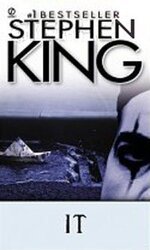
A promise made twenty-eight years ago calls seven adults to reunite in Derry, Maine, where as teenagers they battled an evil creature that preyed on the city’s children. Unsure that their Losers Club had vanquished the creature all those years ago, the seven had vowed to return to Derry if IT should ever reappear. Now, children are being murdered again and their repressed memories of that summer return as they prepare to do battle with the monster lurking in Derry’s sewers once more.
Авторы: King Stephen Edwin
some of the skeletons in Derry’s closet. There is a library Board of Directors. Eleven of them. One is a seventy-year-old writer who suffered a stroke two years ago and who now often needs help to find his place on each meeting’s printed agenda (and who has sometimes been observed picking large dry boogers out of his hairy nostrils and placing them carefully in his ear, as if for safe-keeping). Another is a pushy woman who came here from New York with her doctor husband and who talks in a constant, whiny monologue about how provincial Derry is, how no one here understands THE JEWISH EXPERIENCE and how one has to go to Boston to buy a skirt one would care to be seen in. Last time this anorexic babe spoke to me without the services of an intermediary was during the Board’s Christmas party about a year and a half ago. She had consumed a pretty large amount of gin, and asked me if anyone in Derry understood THE BLACK EXPERIENCE. I had also consumed a pretty large amount of gin, and answered: ‘Mrs Gladry, Jews may be a great mystery, but niggers are understood the whole world round.’ She choked on her drink, whirled around so sharply that her panties were momentarily visible under her flaring skirt (not a very interesting view; would that it had been Carol Danner!), and so ended my last informal conversation with Mrs Ruth Gladry. No great loss.
The other members of the Board are the descendants of the lumber barons. Their support of the library is an act of inherited expiation; they raped the woods and now care for these books the way a libertine might decide, in his middle age, to provide for the gaily gotten bastards of his youth. It was their grandfathers and great-grandfathers who actually spread the legs of the forests north of Derry and Bangor and raped those green-gowned virgins with their axes and peaveys. They cut and slashed and strip –timbered and never looked back. They tore the hymen of those great forests open when Grover Cleveland was President and had pretty well finished the job by the time Woodrow Wilson had his stroke. These lace-ruffled ruffians raped the great woods, impregnated them with a litter of slash and junk spruce, and changed Derry from a sleepy little ship –building town into a booming honky-tonk where the ginmills never closed and the whores turned tricks all night long. One old campaigner, Egbert Thoroughgood, now ninety-three, told me of taking a slat-thin prostitute in a crib on Baker Street (a street which no longer exists; middle –class apartment housing stands quietly where Baker Street once boiled and brawled).
‘I only realized after I spent m’spunk in her that she was laying in a pool of jizzum maybe an inch deep. Stuff had just about gone to jelly. «Girl,» I says, «ain’t you never cared for y’self?» She looks down and says, «I’ll put on a new sheet if you want to go again. There’s two in the cu’bud down the hall, I think. I knows pretty much what I’m layin in until nine or ten, but by midnig ht my cunt’s so numb it might’s well be in Ellsworth.»‘
So that was Derry right through the first twenty or so years of the twentieth century: all boom and booze and balling. The Penobscot and the Kenduskeag were full of floating logs from ice-out in April to ice-in in November. The business began to slacken off in the twenties without the Great War or the hardwoods to feed it, and it staggered to a stop during the Depression. The lumber barons put their money in those New York or Boston banks that had survived the Crash and left Derry’s economy to live — or die — on its own. They retreated to their gracious houses on West Broadway and sent their children to private schools in New Hampshire, Massachusetts, and New York. And lived on their interest and political connections.
What’s left of their supremacy seventy-some years after Egbert Thoroughgood spent his love with a dollar whore in a spermy Baker Street bed are empty wildwoods in Penobscot and Aroostook Counties and the great Victorian houses which stand for two blocks along West Broadway . . . and my library, of course. Except those good folks from West Broadway would take ‘my library’ away from me in jig time (pun definitely intended) if I published anything about the Legion of Decency, the fire at the Black Spot, the execution of the Bradley Gang . . . or the affair of Claude Heroux and the Silver Dollar.
The Silver Dollar was a beerjoint, and what may have been the queerest mass murder in the entire history of America took place there in September of 1905. There are still a few old timers in Derry who claim to remember it, but the only account that I really trust is Thoroughgood’s. He was eighteen when it happened.
Thoroughgood now lives in the Paulson Nursing Home. He’s toothless, and his St John’s Valley Franco/Downcast accent is so thick that