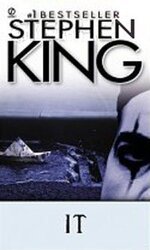
A promise made twenty-eight years ago calls seven adults to reunite in Derry, Maine, where as teenagers they battled an evil creature that preyed on the city’s children. Unsure that their Losers Club had vanquished the creature all those years ago, the seven had vowed to return to Derry if IT should ever reappear. Now, children are being murdered again and their repressed memories of that summer return as they prepare to do battle with the monster lurking in Derry’s sewers once more.
Авторы: King Stephen Edwin
four of them who spent that night in the Brentwood Arms Hotel, which was then called the Floating Dog by the lumbermen (the reason why is lost in obscurity — not even Egbert Thoroughgood remembers). Four checked in; none checked out. One of them, Andy DeLesseps, was never seen again; for all history tells he might have spent the rest of his life living in pleasant ease in Portsmouth. But somehow I doubt it. Two of the other ‘ringleaders,’ Amsel Bickford and Davey Hartwell himself, were found floating facedown in the Kenduskeag. Bickford was missing his head; someone had taken it off with the swipe of a woodsman’s two-hander. Both of Hartwell’s legs were gone, and those who found him swore that they had never seen such an expression of pain and horror on a human face. Something had distended his mouth, stuffing out his cheeks, and when his discoverers turned him over and spread his lips, seven of his toes fell out onto the mud. Some thought he might have lost the other three during his years working in the woods; others held the opinion that he might have swallowed them before he died.
Pinned to the back of each man’s shirt was a paper with the word UNION on it.
Claude Heroux was never brought to trial for what happened in the Silver Dollar on the night of September 9th, 1905, so there’s no way of knowing exactly how he escaped the fate of the others that night in May. We could make assumptions; he had been on his own a long time, had learned how to jump fast, had perhaps developed the knack some cur-dogs have of getting out just before real trouble develops. But why didn’t he take Hartwell with him? Or was he perhaps taken into the woods with the rest of the ‘agitators’? Maybe they were saving him for last, and he was able to get away even while Hartwell’s screams (which would have
grown muffled as they jammed his toes into his mouth) were echoing in the dark and scaring birds off their roosts. There’s no way of knowing, not for sure, but that last feels right to my heart.
Claude Heroux became a ghost-man. He would come strolling into a camp in the St John’s Valley, line up at the cook-shed with the rest of the loggers, get a bowl of stew, eat it, and be gone before anyone realized he wasn’t one of the topping gang. Weeks after that he’d show up in a Winterport beerjoint, talking union and swearing he’d have his revenge on the men that had murdered his friends — Hamilton Tracker, William Mueller, and Richard Bowie were the names he mentioned the most frequently. All of them lived in Derry, and their gabled gambrelled cupola-ed houses stand on West Broadway to this day. Years later, they and their descendants would fire the Black Spot.
That there were people who would have liked Claude Heroux put out of the way cannot be doubted, particularly after the fires started in June of that year. But although Heroux was seen frequently, he was quick and had an animal’s awareness of danger. So far as I have been able to find out, no official warrant was ever sworn out against him, and the police never took a hand. Maybe there were fears about what Heroux might say if he was brought to trial for arson.
Whatever the reasons, the woods around Derry and Haven burned all that hot summer. Children disappeared, there were more fights and murders than usual, and a pall of fear as real as the smoke you could smell from the top of Up-Mile Hill lay over the town.
The rains finally came on September first, and it rained for a solid week. Downtown Derry was flooded out, which was not unusual, but the big houses on West Broadway were high above downtown, and in some of those big houses there must have been sighs of relief. Let the crazy Canuck hide out in the woods all whiter, if that’s what he wants, they might have said. His work’s done for this summer, and we’ll get him before the roots dry next June.
Then came September 9th. I cannot explain what happened; Thoroughgood cannot explain it; so far as I know, no one can. I can only relate the events which occurred.
The Sleepy Silver Dollar was full of loggers drinking beer. Outside, it was drawing down toward misty dark. The Kenduskeag was high and silver-sullen, filling its channel from bank to bank, and according to Egbert Thoroughgood, a fallish wind was blowin — the kine dat alms fine de hole in y’paints and blow strayduppa cracka yo ais.’ The streets were quagmires. There was a card game going on at one of the tables in the back of the room. They were William Mueller’s men. Mueller was part owner of the GS&WM rail line as well as a lumber potentate who owned millions of acres of prime timber, and the men who were playing poker around an oilcloth-covered table in the Dollar that night were part-time lumbermen, part-time railroad bulls, and full time trouble. Two of them, Tinker McCutcheon and Floyd Calderwood,