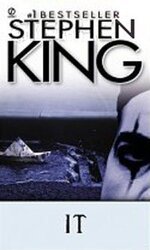
A promise made twenty-eight years ago calls seven adults to reunite in Derry, Maine, where as teenagers they battled an evil creature that preyed on the city’s children. Unsure that their Losers Club had vanquished the creature all those years ago, the seven had vowed to return to Derry if IT should ever reappear. Now, children are being murdered again and their repressed memories of that summer return as they prepare to do battle with the monster lurking in Derry’s sewers once more.
Авторы: King Stephen Edwin
had done jail-time. With them were Lathrop Rounds (his nickname, as obscure as The Floating Dog Hotel, was El Katook), David ‘Stugley’ Grenier, and Eddie King — a bearded man whose spectacles were almost as fat as his gut. It seems very likely that they were at least some of the men who had spent the last two and a half months keeping an eye out for Claude Heroux. It seems just as likely — although there is not a shred of proof — that they were in on the little cutting party in May when Hartwell and Bickford were laid low.
The bar was crowded, Thoroughgood said; dozens of men were bellied up there, drinking beer and eating bar lunches and dripping onto the sawdust-covered dirt floor.
The door opened and in came Claude Heroux. He had a woodsman’s double-bitted axe in his hand. He stepped up to the bar and elbowed himself a place. Egbert Thoroughgood was standing on his left; he said that Heroux smelled like a polecat stew. The barman brought Heroux a schooner of beer, two hard-cooked eggs in a bowl, and a shaker of salt. Heroux paid him with a two-dollar bill and put his change — a dollar-eighty-five — into one of the flap
pockets of his lumberman’s jacket. He salted his eggs and ate them. He salted his beer, drank it off, and uttered a belch.
‘More room out than there is in, Claude,’ Thoroughgood said, just as if half the enforcers in northern Maine hadn’t been on the prod for Heroux all that summer.
‘You know that’s the truth,’ Heroux said, except, being a Canuck, what he probably said came out sounding more like ‘You know dot da troot.’
He ordered himself another schooner, drank up, and belched again. Talk at the bar went on; there was no silence like the ones in the western movies when the good guy or the bad guy pushes his way through the batwings and makes his ominous way to the bar. Several people called to him. Claude nodded and waved, but he didn’t smile. Thoroughgood said he looked like a man who was half in a dream. At the table in back, the poker game went on. El Katook was dealing. No one bothered to tell any of the players that Claude Heroux was in the bar . . . although, since their table was no more than twenty feet away, and since Claude’s name was hollered more than once by people who knew him, it is hard to know how they could have gone on playing, unaware of his potentially murderous presence. But that is what occurred.
After he finished his second schooner of beer, Heroux excused himself to Thoroughgood, picked up his two-hander, and went back to the table where Mueller’s men were playing five –card stud. Then he started cutting.
Floyd Calderwood had just poured himself a glass of rye whiskey and was setting the bottle back down when Heroux arrived and chopped Calderwood’s hand off at the wrist. Calderwood looked at his hand and screamed; it was still holding the bottle but all of a sudden wasn’t attached to anything but wet gristle and trailing veins. For a moment the severed hand clutched the bottle even tighter, and then it fell off and lay on the table like a dead spider. Blood spouted from his wrist.
At the bar, somebody called for more beer and someone else asked the bartender, whose name was Jonesy, if he was still dying his hair. ‘Never dyed it,’ Jonesy said in an ill-tempered way; he was vain of his hair.
‘Met a whore down at Ma Courtney’s who said what grows around your pecker is just as white as snow,’ the fellow said.
‘She was a liar,’ Jonesy replied.
‘Drop your pants and let’s us see,’ said a lumberman named Falkland, with whom Egbert Thoroughgood had been matching for drinks before Heroux came in. This provoked general laughter.
Behind them, Floyd Calderwood was shrieking. A few of the men leaning against the bar took a casual look around in time to see Claude Heroux bury his woodsman’s axe in Tinker McCutcheon’s head. Tinker was a big man with a black beard going gray. He got halfway up, blood pouring down his face in freshets, then sat down again. Heroux pulled the axe out of his head. Tinker started to get up again, and Heroux slung the axe sideways, burying it in his back. It made a sound, Thoroughgood said, like a load of laundry being dropped on a rug. Tinker flopped over the table, his cards spraying out of his hand.
The others players were hollering and bellowing. Calderwood, still shrieking, was trying to pick up his right hand with his left as his life’s blood ran out of his stump of a wrist in a steady stream. Stugley Grenier had what Thoroughgood called a ‘clutch-pistol’ (meaning a gun in a shoulder-holster) and he was grabbing for it with no success whatsoever. Eddie King tried to get up and fell right out of his chair on his back. Before he could get up, Heroux was standing astride him, the axe slung up over his head. King screamed and held up both