
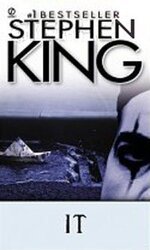
A promise made twenty-eight years ago calls seven adults to reunite in Derry, Maine, where as teenagers they battled an evil creature that preyed on the city’s children. Unsure that their Losers Club had vanquished the creature all those years ago, the seven had vowed to return to Derry if IT should ever reappear. Now, children are being murdered again and their repressed memories of that summer return as they prepare to do battle with the monster lurking in Derry’s sewers once more.
Авторы: King Stephen Edwin
in the Dollar and who, by then, was so exquisitely slopped that he didn’t know if he was on land or at sea. He kicked the head away without looking down to see what it was, and hollered for Jonesy to run him down another beer.
El Katook crawled another three feet, blood spraying from his neck in a high-tension jet, before he realized he was dead and collapsed. That left Stugley. Heroux turned on him, but Stugley had run into the outhouse and locked the door.
Heroux chopped his way in, hollering and blabbering and raving, slobber falling from bis jaws. When he got in Stugley was gone, although the cold, leaky little room was windowless. Heroux stood there for a moment, head lowered, powerful arms slimed and splattered with blood, and then, with a roar, he flipped up the lid of the three-holer. He was just in time to see Stugley’s boots disappearing under the ragged board skirting of the outhouse wall. Stugley Grenier ran screaming down Exchange Street in the rain, beshitted from top to toe, crying that he was being murdered. He survived the cutting party in the Silver Dollar — he was the only one who did — but after three months of listening to jokes about his method of escape, he quitted the Derry area forever.
Heroux stepped out of the toilet and stood in front of it like a bull after a charge, head down, his axe held in front of him. He was puffing and blowing and covered with gore from head to foot.
‘Shut the door, Claude, that shitpot stinks to high heaven,’ Thoroughgood said. Claude dropped his ax e on the floor and did as he had been asked. He walked over to the card-strewn table where his victims had been sitting, kicking one of Eddie King’s severed legs out of his way. Then he simply sat down and put his head in his arms. The drinking and conversation at the bar went on. Five minutes later more men began to pile in, three or four sheriffs deputies among them (the one in charge was Lal Machen’s father, and when he saw the mess he had a heart attack and had to be taken away to Dr Shratt’s office). Claude Heroux was led away. He was docile when they took him, more asleep than awake.
That night the bars all up and down Exchange and Baker Streets boomed and hollered with news of the slaughter. A righteous drunken sort of fury began to build up, and when the bars closed better than seventy men headed downtown toward the jail and the court-house. They had torches and lanterns. Sonic were carrying guns, some had axes, some had peavies.
The County Sheriff wasn’t due from Bangor until the noon stage the next day, so he wasn’t there, and Goose Machen was laid up in Dr Shratt’s infirmary with his heart attack. The two deputies who were sitting in the office playing cribbage heard the mob coming and got out of there fast. The drunks broke in and dragged Claude Heroux out of his cell. He didn’t protest much; he seemed dazed, vacant.
They carried him on their shoulders like a football hero; down to Canal Street they carried him, and there they lynched him from an old elm that overhung the Canal. ‘He was so far gone that he didn’t kick but twice,’ Egbert Thoroughgood said. It was, so far as the town records show, the only lynching to ever take place in this part of Maine. And almost needless to say, it was not reported in the Derry News. Many of those who had gone on drinking unconcernedly while Heroux went about his business in the Silver Dollar were in the necktie party that strung him up. By midnight their mood had changed.
I asked Thoroughgood my final question: had he seen anyone he didn’t know during that day’s violent activities? Someone who struck him as strange, out of place, funny, even clownish? Someone who would have been drinking at the bar that afternoon, someone who had maybe turned into one of the rabble-rousers that night as the drinking went on and the talk turned to lynching?
‘Mayhap there was,’ Thoroughgood replied. He was tired by then, drooping, ready for his afternoon nap. ‘It were a long time ago, mister. Long and long.’
‘But you remember something,’ I said.
‘I remember thinkin that there must be a county fair up Bangor way,’ Thoroughgood said. ‘I was having a beer in the Bloody Bucket that night. The Bucket was about six doors from the Silver Dollar. There was a fella in there . . . comical sort of fella . . . doing flips and rollovers . . . jugglin glasses . . . tricks . . . put four dimes on his forrid and they’d stay right there . . . comical, you know . . . ‘
His bony chin had sunk to his chest again. He was going to sleep right in front of me. Spittle began to bubble at the corners of his mouth, which had as many tucks and wrinkles as a lady’s change-purse.
‘Seen him a few now’ n thens since,’ Thoroughgood said. ‘Figure maybe he had such a good time that night . . . that he decided to stick around.’