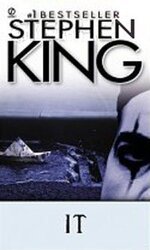
A promise made twenty-eight years ago calls seven adults to reunite in Derry, Maine, where as teenagers they battled an evil creature that preyed on the city’s children. Unsure that their Losers Club had vanquished the creature all those years ago, the seven had vowed to return to Derry if IT should ever reappear. Now, children are being murdered again and their repressed memories of that summer return as they prepare to do battle with the monster lurking in Derry’s sewers once more.
Авторы: King Stephen Edwin
‘Yeah. He’s been around a long time,’ I said.
His only response was a weak snore. Thoroughgood had gone to sleep in his chair by the window, with his medicines and nostrums lined up beside him on the sill, soldiers of old age at muster. I turned off my tape-recorder and just sat looking at him for a moment, this strange time –traveller from the year 1890 or so, who remembered when there were no cars, no electric lights, no airplanes, no state of Arizona. Pennywise had been there, guiding them down the path toward another gaudy sacrifice — just one more in Derry’s long history of gaudy sacrifices. That one, in September of 1905, ushered in a heightened period of terror that would include the Easter-tide explosion of the Kitchener Ironworks the following year.
This raises some interesting (and, for all I know, vitally important) questions. What does It really eat, for instance? I know that some of the children have been partially eaten — they show bite-marks, at least — but perhaps it is we who drive It to do that. Certainly we have all been taught since earliest childhood that what the monster does when it catches you in the deep wood is eat you. That is perhaps the worst thing we can conceive. But it’s really faith that monsters live on, isn’t it? I am led irresistibly to this conclusion: Food may be life, but the source of power is not food but faith. And who is more capable of a total act of faith than a child?
But there’s a problem: kids grow up. In the church, power is perpetuated and renewed by periodic ritualistic acts. In Derry, power seems to be perpetuated and renewed by periodic ritualistic acts, too. Can it be that It protects Itself by the simple fact that, as the children grow into the adults, they become either incapable of faith or crippled by a sort of spiritual and imaginative arthritis?
Yes. I think that’s the secret here. And if I make the calls, how much will they remember? How much will they believe? Enough to end this horror once and for all, or only enough to get them killed? They are being called — I know that much. Each murder in this new cycle has been a call. We almost killed It twice, and in the end we drove It deep in Its warren of tunnels and stinking rooms under the city. But I think It knows another secret: although It ma y be immortal (or almost so), we are not. It had only to wait until the act of faith, which made us potential monster-killers as well as sources of power, had become impossible. Twenty-seven years. Perhaps a period of sleep for It, as short and refreshing as an afternoon nap would be for us. And when It awakes, It is the same, but a third of our lives has gone by. Our perspectives have narrowed; our faith in the magic that makes magic possible, has worn off like the shine on a new pair of shoes after a hard day’s walking.
Why call us back? Why not just let us die? Because we nearly killed It, because we frightened It, I think. Because It wants revenge.
And now, now that we no longer believe in Santa Claus, the Tooth Fairy, Hansel and Gretel, or the troll under the bridge, It is ready for us. Come on back, It says. Come on back,
let’s finish our business in Derry. Bring your jacks and your marbles and your yo-yos! We’ll play. Come on back and we’ll see if you remember the simplest thing of all: how it is to be children, secure in belief and thus afraid of the dark. On that one, at least I score a thousand per cent: I am frightened. So goddam frightened.
‘It is not to be done. The seepage has rotted out the curtain. The mesh is decayed. Lo osen the flesh from the machine, build no more bridges. Through what air will you fly to span the continents? Let the words fall any way at all — that they may hit love aslant. It will be a rare visitation. They want to rescue too much, the flood has done its work’
— William Carlos Williams, Paterson
‘Look and remember. Look upon this land, Far, far across the factories and the grass. Surely, there, surely they will let you pass. Speak then and ask the forest and the loam. What do you hear? What does the land command? The earth is taken: this is not your home.’
— Karl Shapiro, ‘Travelogue for Exiles’
1
The Derry Public Library / 1:15 A.M .
When Ben Hanscom finished the story of the silver slugs, they wanted to talk, but Mike told them he wanted them all to get some sleep. ‘You’ve had enough for now,’ he said, but Mike was the one who looked as if he had had enough; his face was tired and drawn, and Beverly thought he looked physically ill.
‘But we’re not done,’ Eddie said. ‘What about the rest of it? I still don’t remember — ‘
‘Mike’s r-r-right,’ Bill said. ‘Either we’ll remember or we w-won’t. I think we w-will. We’ve remembered all that we nuh-need to.’
‘Maybe all that’s good for us?’ Richie suggested.
Mike nodded. ‘We’ll meet tomorrow.’ Then he glanced at the clock. ‘Later today, I mean.’
‘Here?’ Beverly asked.
Mike shook his head slowly. ‘I suggest we meet on Kansas Street. Where Bill used to hide his bike.’
‘We’re going down into the Barrens,’ Eddie said, and suddenly