
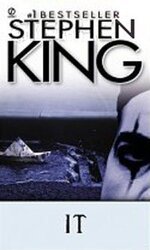
A promise made twenty-eight years ago calls seven adults to reunite in Derry, Maine, where as teenagers they battled an evil creature that preyed on the city’s children. Unsure that their Losers Club had vanquished the creature all those years ago, the seven had vowed to return to Derry if IT should ever reappear. Now, children are being murdered again and their repressed memories of that summer return as they prepare to do battle with the monster lurking in Derry’s sewers once more.
Авторы: King Stephen Edwin
and the rush of crazy exhilaration made him grin.
The playing cards, which had been firing isolated shots, now began to click-clock faster. They were new, nice new Bikes, and they made a good loud sound. Bill felt the first touch of breeze on his bald pate, and his grin widened. I made that breeze, he thought. I made it bypumping these damn pedals.
The STOP sign at the end of the lane was coming up. Bill began to brake . . . and then (his grin still widening, showing more and more of his teeth) he began to pump again.
Ignoring the STOP sign, Bill Denbrough swept to the left, onto Upper Main Street above Bassey Park. Again Audra’s weight fooled him and they almost overbalanced and crashed. The bike wavered, wobbled, then righted itself. That breeze was stronger now, cooling the sweat on his forehead, evaporating it, rushing past his ears with a low intoxicating sound that was a little like the sound of the ocean in a conch shell but was really like nothing else on earth. Bill supposed it was a sound the kid with the skateboard was familiar with. But it’s asound you’ll fall out of touch with, kid, he thought. Things have a way of changing. It’s a dirty trick, so be prepared for it.
Pedaling faster now, finding a surer balance in speed. The ruins of Paul Bunyan on the left, like a fallen colossus. Bill shouted: ‘Hi-yo Silver, AWAYYYYY!’
Audra’s hands tightened around his middle; he felt her stir against his back. But there was no urge to turn and try to see her now . . . no urge, no need. He pedaled faster, laughing out loud, a tall skinny bald man on a bike crouched over the handlebars to lessen the wind-resistance. People turned to look as he raced alongside Bassey Park.
Now Upper Main Street began to incline toward the caved-in center of town at a steeper angle, and a voice inside whispered to him that if he didn’t brake soon he would find himself unable; he would simply go sweeping into the sunken remains of the three-way intersection like a bat out of hell and kill both of them.
Instead of braking he began to pedal again, urging the bike to go even faster. Now he was flying down Main Street Hill and he could see the white-and –orange crash barriers, the smudgepots with their smoky Halloween flames marking the edge of the cave-in, he could see the tops of buildings which jutted out of the streets like the figments of a madman’s imagination.
‘Hi-yo Silver, AWAYYYYYYY!’ Bill Denbrough cried deliriously, and rushed down the hill toward whatever there would be, aware for one last time of Derry as his place, aware most of all that he was alive under a real sky, and that all was desire, desire, desire.
He raced down the hill on Silver: he raced to beat the devil.
6
leaving.
So you leave, and there is an urge to look back, to look back just once as the sunset fades, to see that severe New England skyline one final time — the spires, the Standpipe, Paul with his axe slung over his shoulder. But it is perhaps not such a good idea to look back — all the stories say so. Look what happened to Lot’s wife. Best not to look back. Best to believe there will be happily ever afters all the way around — and so there may be; who is to say there will not be such endings? Not all boats which sail away into darkness never find the sun again, or the hand of another child; if life teaches anything at all, it teaches that there are so many happy endings that the man who believes there is no God needs his rationality called into serious question.
You leave and you leave quick when the sun starts to go down, he thinks in this dream. That’s what you do. And if you spare a last thought, maybe it’s ghosts you wonder about . . . the ghosts of children standing in the water at sunset, standing in a circle, standing with their hands joined together, their faces young, sure, but tough . . . tough enough, anyway, to give birth to the people they will become, tough enough to understand, maybe, that the people they will become must necessarily birth the people they were before they can get on with trying to understand simple mortality. The circle closes, the wheel rolls, and that’s all there is.