
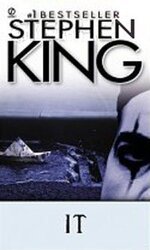
A promise made twenty-eight years ago calls seven adults to reunite in Derry, Maine, where as teenagers they battled an evil creature that preyed on the city’s children. Unsure that their Losers Club had vanquished the creature all those years ago, the seven had vowed to return to Derry if IT should ever reappear. Now, children are being murdered again and their repressed memories of that summer return as they prepare to do battle with the monster lurking in Derry’s sewers once more.
Авторы: King Stephen Edwin
‘I suggest,’ the instructor says, toying with his pen and smiling at Bill with half-lidded eyes, ‘that you have a great deal to learn.’
The applause starts somewhere in the back of the room.
Bill leaves . . . but returns the next week, determined to stick with it. In the time between he ha s written a story called ‘The Dark,’ a tale about a small boy who discovers a monster in the cellar of his house. The little boy faces it, battles it, finally kills it. He feels a land of holy exaltation as he goes about the business of writing this story; he even feels that he is not so much telling the story as he is allowing the story to flow through him. At one point he puts his pen down and takes his hot and aching hand out into ten-degree December cold where it nearly smokes from the temperature change. He walks around, green cut– off boots squeaking in the snow like tiny shutter-hinges which need oil, and his head seems to bulge with the story; it is a little scary, the way it needs to get out. He feels that if it cannot escape by way of his racing ha nd that it will pop his eyes out in its urgency to escape and be concrete. ‘Going to knock the shit out of it,’ he confides to the blowing winter dark, and laughs a little — a shaky laugh. He is aware that he has finally discovered how to do just that — after ten years of trying he has suddenly found the starter button on the vast dead bulldozer taking up so much space inside his head. It has started up. It is revving, revving. It is nothing pretty, this big machine. It was not made for taking pretty girls to proms. It is not a status symbol. It means business. It can knock things down. If he isn’t careful, it will knock him down.
He rushes inside and finishes ‘The Dark’ at white heat, writing until four o’clock in the morning and finally falling asleep over his ring –binder. If someone had suggested to him that
he was really writing about his brother, George, he would have been surprised. He has not thought about George in years — or so he honestly believes.
The story comes back from the instructor with an F slashed into the tide page. Two words are scrawled beneath, in capital letters. PULP, screams one. CRAP, screams the other.
Bill takes the fifteen-page sheaf of manuscript over to the wood-stove and opens the door. He is within a bare inch of tossing it in when the absurdity of what he is doing strikes him. He sits down in his rocking chair, looks at a Grateful Dead poster, and starts to laugh. Pulp? Fine! Let it be pulp! The woods were full of it!
‘Let them fucking trees fall!’ Bill exclaims, and laughs until tears spurt from his eyes and roll down his face.
He retypes the title page, the one with the instructor’s judgment on it, and sends it off to a men’s magazine named White Tie (although from what Bill can see, it really should be titled Naked Girls Who Look Like Drug Users’). Yet his battered Writer’s Market says they buy horror stories, and the two issues he has bought down at the local mom-and-pop store have indeed contained four horror stories sandwiched between the naked girls a nd the ads for dirty movies and potency pills. One of them, by a man named Dennis Etchison, is actually quite good.
He sends ‘The Dark’ off with no real hopes — he has submitted a good many stories to magazines before with nothing to show for it but rejection slips — and is flabbergasted and delighted when the fiction editor of White Tie buys it for two hundred dollars, payment on publication. The assistant editor adds a short note which calls it ‘the best damned horror story since Ray Bradbury’s «The Jar.»‘ He adds, ‘Too bad only about seventy people coast to coast will read it,’ but Bill Denbrough does not care. Two hundred dollars!
He goes to his advisor with a drop card for Eh-141. His advisor initials it. Bill Denbrough staples the drop card to th e assistant fiction editor’s congratulatory note and tacks both to the bulletin board on the creative-writing instructor’s door. In the corner of the bulletin board he sees an anti-war cartoon. And suddenly, as if moving of its own accord, his fingers pluck his pen from his breast pocket and across the cartoon he writes this: If fiction and politics everreally do become interchangeable, I’m going to kill myself, because I won’t know what else to do. You see, politics always change. Stories never do. He pauses, and then, feeling a bit small (but unable to help himself), he adds: I suggest you have a lot to learn.