
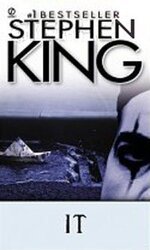
A promise made twenty-eight years ago calls seven adults to reunite in Derry, Maine, where as teenagers they battled an evil creature that preyed on the city’s children. Unsure that their Losers Club had vanquished the creature all those years ago, the seven had vowed to return to Derry if IT should ever reappear. Now, children are being murdered again and their repressed memories of that summer return as they prepare to do battle with the monster lurking in Derry’s sewers once more.
Авторы: King Stephen Edwin
at you, Bill, and I saw someone who never ran on the walkway, because he knew it would get him there. You seemed utterly untouched by the hype and hysteria. You didn’t lease a Rolls so you could drive down Rodeo Drive on Saturday afternoon with your own vanity plates on some glitzy rental company’s car. You didn’t have a press agent to plant items in Variety or The Hollywood Reporter. You’d never done the Carson show.’
‘Writers can’t unless they also do card-tricks or bend spoons,’ he said, smiling. ‘It’s like a national law.’
He thought she would smile, but she didn’t. ‘I know you were there when I needed you. When I came flying off the end of the walkway like O. J. Simpson in that old Hertz ad. Maybe you saved me from eating the wrong pill on top of too much booze. Or maybe I would have made it out the other side on my own and it’s all a big dramatization on my part. But . . . it doesn’t feel like that. Not inside, where I am.’
She snuffed the cigarette, only two puffs gone.
‘I know you’ve been there ever since. And I’ve been there for you. We’re good in bed. That used to seem like a big deal to me. But we’re also good out of it, and now that seems like a bigger deal. I feel as if I could grow old with you and still be brave. I know you drink too much beer and don’t get enough exercise; I know that some nights you dream badly — ‘
He was startled. Nastily startled. Almost frightened.
‘I never dream.’
She smiled. ‘So you tell the interviewers when they ask where you get your ideas. But it’s not true. Unless it’s just indigestion when you start groaning in the night. And I don’t believe that, Billy.’
‘Do I talk?’ he asked cautiously. He could remember no dreams. No dreams at all, good or bad.
Audra nodded. ‘Sometimes. But I can never make out what it is you say. And on a couple of occasions, you have wept.’
He looked at her blankly. There was a bad taste in his mouth; it trailed back along his tongue and down his throat like the taste of melted aspirin. So now you know how fear tastes, he thought. Time you found out, considering all you’ve written on the subject. He supposed it was a taste he would get used to. If he lived long enough.
Memories were suddenly trying to crowd in. It was as if a black sac in his mind were bulging, threatening to spew noxious
(dreams)
images up from his subconscious and into the mental field of vision commanded by his rational waking mind — and if that happened all at once, it would drive him mad. He tried to push them back, and succeeded, but not before he heard a voice — it was as if someone buried alive had cried out from the ground. It was Eddie Kaspbrak’s voice.
You saved my life, Bill. Those big boys, they drive me bugshit. Sometimes I think they really want to kill me —
‘Your arms,’ Audra said.
Bill looked down at them. The flesh there had humped into gooseflesh. Not little bumps but huge white knobs like insect eggs. They both stared, saying nothing, as if looking at an interesting museum exhibit. The goosebumps slowly melted away.
In the silence that followed Audra said: ‘And I know one other thing. Someone called you this morning from the States and said you have to leave me.’
He got up, looked briefly at the liquor bottles, then went into the kitchen and came back with a glass of orange juice. He said: ‘You know I had a brother, and yo u know he died, but you don’t know he was murdered.’
Audra took in a quick snatch of breath.
‘Murdered! Oh, Bill, why didn’t you ever — ‘
‘Tell you?’ He laughed, that barking sound again. ‘I don’t know.’
‘What happened?’
‘We were living in Derry then. There had been a flood, but it was mostly over, and George was bored. I was sick in bed with the flu. He wanted me to make him a boat out of a sheet of newspaper. I knew how from daycamp the year before. He said he was going to sail it down the gutters on Witcham Street and Jackson Street, because they were still full of water. So I made him the boat and he thanked me and he went out and that was the last time I ever saw my brother George alive. If I hadn’t had the flu, maybe I could have saved him.’
He paused, right palm rubbing at his left cheek, as if testing for beard-stubble. His eyes, magnified by the lenses of his glasses, looked thoughtful . . . but he was not looking at her.
‘It happened right there on Witcham Street, not too far from the intersection with Jackson. Whoever killed him pulled his left arm off the way a second-grader