
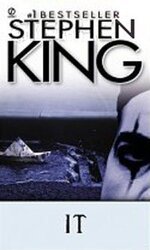
A promise made twenty-eight years ago calls seven adults to reunite in Derry, Maine, where as teenagers they battled an evil creature that preyed on the city’s children. Unsure that their Losers Club had vanquished the creature all those years ago, the seven had vowed to return to Derry if IT should ever reappear. Now, children are being murdered again and their repressed memories of that summer return as they prepare to do battle with the monster lurking in Derry’s sewers once more.
Авторы: King Stephen Edwin
the thing that was here in 1876 and 1877, the thing that has shown up every twenty-seven years or so. Sometimes it comes a little sooner, sometimes a little later . . . but it always comes. As one goes back the wrong notes are harder and harder to find because the records grow poorer and the moth-holes in the narrative history of the area grow bigger. But knowing where to look — and when to look — goes a long way toward solving the problem. It always comes back, you see.
It.
So — yes: I think I’ll have to make those calls. I think it was meant to be us. Somehow, for some reason, we’re the ones who have been elected to stop it forever. Blind fate? Blind luck? Or is it that damned Turtle again? Does it perhaps command as well as speak? I don’t know. And I doubt if it matters. All those years ago Bill said The Turtle can’t help us, and if it was true then it must be true now.
I think of us standing in the water, hands clasped, making that promise to come back if it ever started again — standing there almost like Druids in a ring, our hands bleeding their own promise, palm to palm. A ritual that is perhaps as old as mankind itself, an unknowing tap driven into the tree of all power — the one that grows on the borderline between the land of all we know and that of all we suspect.
Because the similarities —
But I’m doing my own Bill Denbrough here, stuttering over the same ground again and again, reciting a few facts and a lot of unpleasant (and rather gaseous) suppositions, growin g more and more obsessive with every paragraph. No good. Useless. Dangerous, even. But it is so very hard to wait on events.
This notebook is supposed to be an effort to get beyond that obsession by widening the focus of my attention — after all, there is more to this story than six boys and one girl, none of them happy, none of them accepted by their peers, who stumbled into a nightmare during one hot summer when Eisenhower was still President. It is an attempt to pull the camera back a little, if you w i l l — to see the whole city, a place where nearly thirty– five thousand people work and eat and sleep and copulate and shop and drive around and walk and go to school and go to jail and sometimes disappear into the dark.
To know what a place is, I really do believe one has to know what it was. And if I had to name a day when all of this really started again for me, it would be the day in the early spring of 1980 when I went to see Albert Carson, who died last summer — at ninety-one, he was full of years as well as honors. He was head librarian here from 1914 to 1960, an incredible span (but he was an incredible man), and I felt that if anyone would know which history of this area was the best one to start with, Albert Carson would. I asked him my question as we sat on his porch and he gave me my answer, speaking in a croak — he was already fighting the throat-cancer which would eventually kill him.
‘Not one of them is worth a shit. As you damn well know.’
‘Then where should I start?’
‘Start what, for Christ’s sake?’
‘Researching the history of the area. Of Derry Township.’
‘Oh. Well. Start with the Fricke and the Michaud. They’re supposed to be the best.’
‘And after I read those — ‘
‘Read them? Christ, no! Throw em in the wastebasket! That’s your first step. Then read Buddinger. Branson Buddinger was a damned sloppy researcher and afflicted with a terminal boner, if half of what I heard when I was a kid was true, but when it came to Derry his heart was in the right place. He got most of the facts wrong, but he got them wrong with feeling, Hanlon.’
I laughed a little and Carson grinned with his leathery lips — an expression of good humor that was actually a little frightening. In that instant he looked like a vulture happily guarding a freshly killed animal, waiting for it to reach exactly the right stage of tasty decomposition before beginning to dine.
‘When you finish with Buddinger, read Ives. Make notes on all the people he talked to. Sandy Ives is still at the University of Maine. Folklorist. After you read him, go see him. Buy him a dinner. I’d take him to the Orinoka, because dinner at the Orinoka seems to never end. Pump him. Fill up a notebook with names and addresses. Talk to the old-timers he’s talked to — those that are still left; there are a few of us, ah-hah-hah-hah! — and get some more names from them. By then you’ll have all the place to stand you’ll need, if you’re half as bright as I think you are. If you chase down enough people, you’ll find out a few things that aren’t in the histories. And you may find they disturb your sleep.’
‘Derry . . . ‘
‘What about it?’
‘Derry’s not right, is it?’
‘Right?’ he asked in that whispery croak.