
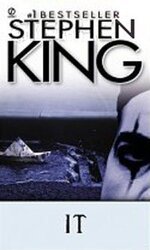
A promise made twenty-eight years ago calls seven adults to reunite in Derry, Maine, where as teenagers they battled an evil creature that preyed on the city’s children. Unsure that their Losers Club had vanquished the creature all those years ago, the seven had vowed to return to Derry if IT should ever reappear. Now, children are being murdered again and their repressed memories of that summer return as they prepare to do battle with the monster lurking in Derry’s sewers once more.
Авторы: King Stephen Edwin
‘What’s right? What does that word mean? Is «right» pretty pictures of the Kenduskeag at sunset, Kodachrome by so-and –so, f-stop such-and –such? If so, then Derry is right, because there are pretty pictures of it by the score. Is right a damned committee of dry-boxed old virgins to save the Governor’s Mansion or to p ut a commemorative plaque in front of the Standpipe? If that’s right, then Derry’s right as rain, because we’ve got more than our share of old kitty-cats minding everybody’s business. Is right that ugly plastic statue of Paul Bunyan in front of City Center? Oh, if I had a truckful of napalm and my old Zippo lighter I’d take care of that fucking thing, I assure you . . . but if
one’s aesthetic is broad enough to include plastic statues, then Derry is right. The question is, what does right mean to you, Hanlon? Eh? More to the point, what does right not mean?’
I could only shake my head. He either knew or he didn’t. He would either tell or he wouldn’t.
‘Do you mean the unpleasant stories you may hear, or the ones you already know? There are always unple asant stories. A town’s history is like a rambling old mansion filled with rooms and cubbyholes and laundry– chutes and garrets and all sorts of eccentric little hiding places . . . not to mention an occasional secret passage or two. If you go exploring Mansion Derry, you’ll find all sorts of things. Yes. You may be sorry later, but you’ll find them, and once a thing is found it can’t be unfound, can it? Some of the rooms are locked, but there are keys . . . there are keys.’
His eyes glinted at me with an old man’s shrewdness.
‘You may come to think you’ve stumbled on the worst of Derry’s secrets . . . but there is always one more. And one more. And one more.’
‘Do you — ‘
‘I think I shall have to ask you to excuse me just now. My throat is very bad today. It’s time for my medicine and my nap.’
In other words, here is a knife and a fork, my friend; go see what you can cut with them.
I started with the Fricke history and the Michaud history. I followed Carson’s advice and threw them in the wastebasket, but I read them first. They were as bad as he had suggested. I read the Buddinger history, copied out the footnotes, and chased them down. That was more satisfactory, but footnotes are peculiar things, you know – like footpaths twisting through a wild and anarchic country. They split, then they split again; at any point you may take a wrong turn which leads you either to a bramble-choked dead end or into swampy quickmud. ‘If you find a footnote,’ a library-science prof once told a class of which I was a part, ‘step on its head and kill it before it can breed.’
They do breed, and sometimes the breeding is a good thing, but I think that more often it is not. Those in Buddinger’s stiffly written A History of Old Derry (Orono: University of Maine Press, 1950) wander through one hundred years’ worth of forgotten books and dusty master’s dissertations in the fields of history and folklore, through articles in defunct magazines, and amid brain-numbing stacks of town reports and ledgers.
My conversations with Sandy Ives were more interesting. His sources crossed Buddinger’s from time to time, but a crossing was all it ever was. Ives had spent a good part of his lifetime setting down oral histories — yarns, in other words — almost verbatim, a practice Branson Buddinger would undoubtedly have seen as taking the low road.
Ives had written a cycle of articles on Derry during the years 1963-66. Most of the old –timers he talked to then were dead by the time I started my own investigations, but they had sons, daughters, nephews, cousins. And, of course, one of the great true facts of the world is this: for every old –timer who dies, there’s a new old-timer coming along. And a good story never dies; it is always passed down. I sat on a lot of porches an d back stoops, drank a lot of tea, Black Label beer, homemade beer, homemade rootbeer, tapwater, springwater. I did a lot of listening, and the wheels of my tape-player turned.
Both Buddinger and Ives agreed completely on one point: the original party of white settlers numbered about three hundred. They were English. They had a charter and were formally known as the Derrie Company. The land granted them covered what is today Derry, most of Newport, and little slices of the surrounding towns. And in the year 1741 everyone in Derry Township just disappeared. They were there in June of that year — a c o m m u n i t y which at that time numbered about three hundred and forty souls — but come October they were gone. The little village of wooden homes stood utterly deserted. One of them, which once stood roughly at the place where Witcham