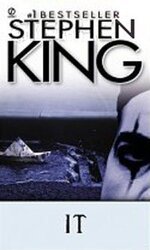
A promise made twenty-eight years ago calls seven adults to reunite in Derry, Maine, where as teenagers they battled an evil creature that preyed on the city’s children. Unsure that their Losers Club had vanquished the creature all those years ago, the seven had vowed to return to Derry if IT should ever reappear. Now, children are being murdered again and their repressed memories of that summer return as they prepare to do battle with the monster lurking in Derry’s sewers once more.
Авторы: King Stephen Edwin
been found, was one of them. During periods of heavy rain, they were all apt to overflow their banks. ‘If it rains two weeks the whole damn town gets a sinus infection,’ Stuttering Bill’s dad had said once.
The Kenduskeag was caged in a concrete canal two miles long as it passed through downtown. This canal dived under Main Street at the intersection of Main and Canal, becoming an underground river for half a mile or so before surfacing again at Bassey Park. Canal Street, where most of Derry’s bars were ranked like felons in a police lineup, paralleled the Canal on its way out of town, and every few weeks or so the police would have to fish
some drunk’s car out of the water, which was polluted to drop-dead levels by sewage and mill wastes. Fish were caught from time to time in the Canal, but they were inedible mutants.
On the northeastern side of town — the Canal side — the river had been managed to at least some degree. A thriving commerce went on all along it in spite of the occasional flooding. People walked beside the Canal, sometimes hand in hand (if the wind was right, that was; if it was wrong, the stench took much of the romance out of such strolling), and at Bassey Park, which faced the high school across the Canal, there were sometimes Boy Scout campouts and Cub Scout wiener roasts. In 1969 the citizens would be shocked and sickened to discover that hippies (one of them had actually sewed an American flag on the seat of his pants, and that pinko-faggot was busted before you could say Gene McCarthy) were smoking dope and trading pills up there. By ’69 Bassey Park had become a regular open-air pharmacy. You just wait, people said. Somebody’ll get killed before they put a stop to it. And of course someone finally did — a seventeen-year-old boy had been found dead by the Canal, his veins full of almost pure heroin — what the kids called a tight white rail. After that the druggies began to drift away from Bassey Park, and there were even stories that the kid’s ghost was haunting the area. The story was stupid, of course, but if it kept the speed-freaks and the nodders away, it was at least a useful stupid story.
On the southwestern side of town the river presented even more of a problem. Here the hills had been deeply cut open by the passing of the great glacier and further wounded by the endless water erosion of the Kenduskeag and its webwork of tributaries; the bedrock showed through in many places like the half-unearthed bones of dinosaurs. Veteran employees of the Derry Public Works Department knew that, following the fall’s first hard frost, they could count on a good deal of sidewalk repair on the southwestern side of town. The concrete would contract and grow brittle and then the bedrock would suddenly shatter up through it, as if the earth meant to hatch something.
What grew best in the shallow soil which remained was plants with shallow root-systems and hardy natures — weeds and trash-plants, in other words: scruffy trees, thick low bushes, and virulent infestations of poison ivy and poison oak grew everywhere they were allowed a foothold. The southwest was where the land fell away steeply to the area that was known in Derry as the Barrens. The Barrens — which were anything but barren — were a messy tract of land about a mile and a half wide by three miles long. It was bounded by upper Kansas Street on one side and by Old Cape on the other. Old Cape was a low-income housing development, and the drainage was so bad over there that there were stories of toilets and sewer-pipes actually exploding.
The Kenduskeag ran through the center of the Barrens. The city had grown up to the northeast and on both sides of it, but the only vestiges of the city down there were Derry Pumphouse #3 (the municipal sewage-pumping station) and the City Dump. Seen from the air the Barrens looked like a big green dagger pointing at downtown.
To Ben all this geography mated with geology meant was a vague awareness that there were no more houses on his right side now; the land had dropped away. A rickety whitewashed railing, about waist-high, ran besid e the sidewalk, a token gesture of protection. He could faintly hear running water; it was the sound-track to his continuing fantasy.
He paused and looked out over the Barrens, still imagining her eyes, the clean smell of her hair.
From here the Kenduskeag was only a series of twinkles seen through breaks in the thick foliage. Some kids said that there were mosquitoes as big as sparrows down there at this time of year; others said there was quicksand as you approached the river. Ben didn’t believe it about the mosquitoes, but the idea of quicksand scared him.