
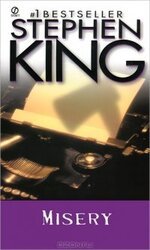
Misery Chastain was dead. Paul Sheldon had just killed her — with relief, with joy. Misery had made him rich; she was the heroine of a string of bestsellers. And now he wanted to get on to some real writing. That’s when the car accident happened, and he woke up in pain in a strange bed. But it wasn’t the hospital.
Авторы: King Stephen Edwin
needed? There’s really no one else.”
“My Lord,” she said numbly. “My Lord Mr. Ian — “
“ — must know nothing of this until we know more!” He said. “If God is good, he need never know at all.” He would not voice to her the unspoken hope at the back of his mind, a hope which seemed to him almost as monstrous as his fears. If God was very good, he would find out about this night’s work… when his wife and only 1ove was restored to him, her return from the dead almost as miraculous as that of Lazarus. IN “Oh, this is terrible… terrible!” she said in a faint, fluttery voice. Holding onto the table, she managed to pull herself to her feet. She stood, swaying, little straggles of hair hanging around her face among the muskrat-tails of her cap.
“Are you well enough?” he asked, more kindly. “If not, then I must try to carry on as best I can by myself.” She drew a deep, shuddering breath and let it out. The side-to-side sway stopped. She turned and walked toward the pantry. “There’s a pair of spades in the shed out back,” she said. “A pick as well, I think. Throw them in your trap. There’s half a bottle of gin out here in the pantry. Been here untouched since Bill died five years ago, on Lammas-night. I’ll have a bit and then join you, Mr. Geoffrey.”
“You’re a brave woman, Mrs. Ramage. Be quick.”
“Aye, never fear me,” she said, and grasped the bottle of gin with a hand that trembled only slightly. There was no dust on the bottle — not even the pa0try was safe from the relentless dust-clout of Mrs. Ramage — but the label reading CLOUGH amp; POOR BOOZIERS was yellow. “Be quick yourself.” She had always hated spirits and her stomach wanted to sick the gin, with its nasty junipery smell and oily taste, back up. She made it stay down. Tonight she would need it.
Under clouds that still raced east to west, blacker shapes against a black sky, and a moon that was now settling toward the horizon, the pony-trap sped toward the churchyard. It was now Mrs. Ramage who drove, cracking the whip over the bewildered Mary, who would have told them, if horses could talk, that this was all wrong — she was supposed to be dozing in her warm stall come this time of night. The spades and the pick chattered coldly one against the other, and Mrs. Ramage thought they would have given anyone who had seen them a proper fright — they must look like a pair of Mr. Dickens’s resurrection men… or perhaps one resurrection man sitting in a pony-trap driven by a ghost. For she was all in white — had not even paused long enough to gather up her robe. Her nightgown fluttered around her stout, vein-puffed ankles, and the tails of her cap streamed wildly out behind her.
Here was the church. She turned Mary up the lane which ran beside it, shivering at the ghostly sound of the wind playing along the eaves. She had a moment to wonder why such a holy place as a church should seem so frightening after dark, and then realized it was not the church… it was the errand.
Her first thought upon coming out of her faint was that My Lord must help them — hadn’t he been there in all things, through thick and thin, never wavering? A moment later she had realized how mad the idea was. This was not a matter of My Lord’s courage, but of his very sanity.
She hadn’t needed Mr. Geoffrey to tell her so; the memory of Miss Evelyn-Hyde had done that.
She realized that neither Mr. Geoffrey nor My Lord had been in Little Dunthorpe when it had happened. This had been almost half a year ago, in the spring. Misery had entered the rosy summer of her pregnancy, morning sickness behind her, the final rising of her belly and its attendant discomfort still ahead, and she had cheerfully sent the two men off for a week of grouse-shooting and card-playing and footballing and heaven alone knew what other masculine foolishness at Oak Hall in Doncaster. My Lord had been a bit doubtful, but Misery assured him she would be fine, and nearly pushed him out the door. That Misery would be fine Mrs. Ramage had no doubt. But whenever My Lord and Mr. Geoffrey left for Doncaster, she wondered if one of them — or perhaps both — might not return on the back of a cart, toes up.
Oak Hall was the inheritance of Albert Fossington, a schoolmate of Geoffrey’s and Ian’s. Mrs. Ramage quite rightly believed that Bertie Fossington was mad. Some three years ago he had eaten his favorite polo pony after it had broken two legs and needed to be destroyed. It was a gesture of affection, he said. “Learned it from the fuzzy-wuzzies in Capetown,” he said. “Griquas. Wonderful chaps. Put sticks and things in their smoochers, what? Some of “em look like they could carry all twelve volumes of the Royal Navigation Charts on their lower lips, ha-ha! Taught me that each make must eat the thing he loves. Rather poetic in a grisly