
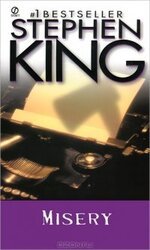
Misery Chastain was dead. Paul Sheldon had just killed her — with relief, with joy. Misery had made him rich; she was the heroine of a string of bestsellers. And now he wanted to get on to some real writing. That’s when the car accident happened, and he woke up in pain in a strange bed. But it wasn’t the hospital.
Авторы: King Stephen Edwin
mail: “Kill that nice Mr Holmes? Foolishness! Don’t you dare!” Or there was the case of his friend Gary Ruddman, who worked for the Boulder Public Library. When Paul had dropped over to see him one day, he had found Gary’s shades drawn and a black crepe fluff on the door. Concerned, Paul had knocked hard until Gary answered. Go away, Gary had told him. I’m feeling depressed today. Someone died. Someone important to me. When Paul asked who, Gary had responded tiredly: Van der Valk. Paul had heard him walk away from the door, and although he knocked again, Gary had not come back. Van der Valk, it turned out, was a fictional detective created — and then uncreated — by a writer named Nicolas Freeling.
Paul had been convinced Gary’s reaction had been more than false; he thought it had been pretentiously arty. In short, a pose. He continued to feel this way until 1983, when he read The World According to Garp. He made the mistake of reading the scene where Garp’s younger son dies, impaled on a gearshift]ever, shortly before bed. It was hours before he slept. The scene would not leave his mind. The thought that grieving for a fictional character was absurd did more than cross his mind during his tossings and turnings. For grieving was exactly what he was doing, of course. The realization had not helped, however, and this had caused him to wonder if perhaps Gary Ruddman hadn’t been a lot more serious about Van der Valk than Paul had given him credit for at the time. And this had caused another memory to resurface: finishing William Golding’s Lord of the Flies at the age of twelve on a hot summer day, going to the refrigerator for a cold glass of lemonade… and then suddenly changing direction and speeding up from an amble to an all-out bolt which had ended in the bathroom. There he had leaned over the toilet and vomited.
Paul suddenly remembered other examples of this odd mania: the way people had mobbed the Baltimore docks each month when the packet bearing the new installment of Mr Dickens’s Little Dorrit or Oliver Twist was due (some had drowned, but this did not discourage the others); the old woman of a hundred and five who had declared she would five until Mr Galsworthy finished The Forsyte Saga — and who had died less than an hour after having the final page of the final volume read to her; the young mountain climber hospitalized with a supposedly fatal case of hypothermia whose friends had read The Lord of the Rings to him nonstop, around the clock, until he came out of his coma; hundred s of other such incidents.
Every “best-selling” writer of fiction would, he supposed, have his own personal example or examples of radical reader involvement with the make-believe worlds the writer creates… examples of the Scheherazade complex, Paul thought now, half-dreaming as the sound of Annie’s mower ebbed and flowed at some great echoing distance. He remembered getting two letters suggesting Misery theme parks, on the order of Disney World or Great Adventure. One of these letters had included a crude blueprint. But the blue-ribbon winner (at least until Annie Wilkes had entered his life) had been Mrs Roman D. Sandpiper III, of Ink Beach, Florida. Mrs Roman D. Sandpiper, whose given name was Virginia, had turned an upstairs room of her home into Misery’s Parlor. She included Polaroids of Misery’s Spinning Wheel, Misery’s Escritoire (complete with a half-completed bread-and-butter note to Mr Faverey, saying she would be in attendance at the School Hall Recitation on 20th Nov. inst. — done in what Paul thought was an eerily apt hand for his heroine, not a round and flowing ladies” script but a half-feminine copperplate), Misery’s Couch, Misery’s Sampler (Let Love Instruct You; Do Not Presume to Instruct Love), etc., etc. The furnishings, Mrs Roman D. («Virginia») Sandpiper’s letter said, were all genuine, not reproductions and while Paul could not tell for sure, he guessed that it was the truth. If so, this expensive bit of make-believe must have cost Mrs Roman D. («Virginia») Sandpiper thousands of dollars. Mrs Roman D. («Virginia») Sandpiper hastened to assure him that she was not using his character to make money, nor did she have any plans in that direction — heaven forbid! — but she did want him to see the pictures, and to tell her what she had wrong (which, she was sure, must be a great deal). Mrs Roman D. («Virginia») Sandpiper also hoped for his opinion. Looking at those pictures had given him a feeling which was strange yet eerily intangible — it had been like looking at photographs of his own imagination, and he knew that from that moment on, whenever he tried to imagine Misery’s little combination parlor and study, Mrs Roman D. («Virginia») Sandpiper’s Polaroids would leap immediately into his mind, obscuring imagination with