
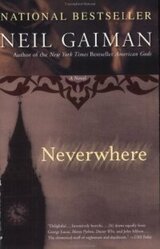
Richard Mayhew is a young man with a good heart and an ordinary life, which is changed forever when he stops to help a girl he finds bleeding on a London sidewalk. His small act of kindness propels him into a world he never dreamed existed. There are people who fall through the cracks, and Richard has become one of them. And he must learn to survive in this city of shadows and darkness, monsters and saints, murderers and angels, if he is ever to return to the London that he knew.
Авторы: Нил Гейман, Terry Pratchett & Neil Gaiman, Mike Carey, Glenn Fabry
just London . . . » The old woman paused. «Not any London I know.» It started to rain then, softly. «I’m sorry,» she said. «It starts with doors.»
«Doors?»
She nodded. The rain fell harder, pattering on the roofs and on the asphalt of the road. «I’d watch out for doors if I were you.»
Richard stood up, a little unsteadily. «All right,» he said, a little unsure of how he ought to treat information of this nature. «I will. Thanks.»
The pub door was opened, and light and noise spilled out into the street. «Richard? You all right?»
«Yeah, I’m fine. I’ll be back in a second.» The old lady was already wobbling down the street, into the pelting rain, getting wet. Richard felt he had to do something for her: he couldn’t give her money, though. He hurried after her, down the narrow street, the cold rain drenching his face and hair. «Here,» said Richard. He fumbled with the handle of the umbrella, trying to find the button that opened it. Then a click, and it blossomed into a huge white map of the London Underground network, each line drawn in a different color, every station marked and named.
The old woman took the umbrella, gratefully, and smiled her thanks. «You’ve a good heart,» she told him. «Sometimes that’s enough to see. you safe wherever you go.» Then she shook her head. «But mostly, it’s not.» She clutched the umbrella tightly as a gust of wind threatened to tug it away from her or pull it inside out. She wrapped her arms around it and bent almost double against the rain and the wind. Then she walked away into the rain and the night, a round white shape covered with the names of London Tube stations – Earl’s Court, Marble Arch, Blackfriars, White City, Victoria, Angel, Oxford Circus . . .
Richard found himself pondering, drunkenly, whether there really was a circus at Oxford Circus: a real circus with clowns, beautiful women, and dangerous beasts. The pub door opened once more: a blast of sound, as if the pub’s volume control had just been turned up high. «Richard, you idiot, it’s your bloody party, and you’re missing all the fun.» He walked back in the pub, the urge to be sick lost in all the oddness.
«You look like a drowned rat,» said someone.
«You’ve never seen a drowned rat,» said Richard.
Someone else handed him a large whisky. «Here, get that down you. That’ll warm you up. You know, you won’t be able to get real Scotch in London.»
«I’m sure I will,» sighed Richard. Water was dripping from his hair into his drink. «They have everything in London.» And he downed the Scotch, and after that someone bought him another, and then the evening blurred and broke up into fragments: afterward he remembered only the feeling that he was about to leave somewhere small and rational—a place that made sense—for somewhere huge and old that didn’t; and vomiting interminably into a gutter flowing with rainwater, somewhere in the small hours of the morning; and a white shape marked with strange-colored symbols, like a little round beetle, walking away from him in the rain.
The next morning he boarded the train for the six-hour journey south that would bring him to the strange gothic spires and arches of St. Pancras Station. His mother gave him a small walnut cake that she had made for the journey and a thermos filled with tea; and Richard Mayhew went to London feeling like hell.
She had been running for four days now, a harum-scarum tumbling flight through passages and tunnels. She was hungry, and exhausted, and more tired than a body could stand, and each successive door was proving harder to open. After four days of flight, she had found a hiding place, a tiny stone burrow, under the world, where she would be safe, or so she prayed, and at last she slept.
Mr. Croup had hired Ross at the last Floating Market, which had been held in Westminster Abbey. «Think of him,» he told Mr. Vandemar, «as a canary.»
«Sings?» asked Mr. Vandemar.
«I doubt it; I sincerely and utterly doubt it.» Mr. Croup ran a hand through his lank orange hair. «No, my fine friend, I was thinking metaphorically—more along the lines of the birds they take down mines.» Mr. Vandemar nodded, comprehension dawning slowly: yes, a canary. Mr. Ross had no other resemblance to a canary. He was huge—almost as big as Mr. Vandemar—and extremely grubby, and quite hairless, and he said very little, although he had made a point of telling each of them that he liked to kill things, and he was good at it; and this amused Mr. Croup and Mr. Vandemar. But he was a canary, and he never knew it. So Mr. Ross went first, in his filthy T-shirt and his crusted blue-jeans, and Croup and Vandemar walked behind him, in their elegant black suits.
There are four simple ways for the observant to tell Mr. Croup and Mr.