
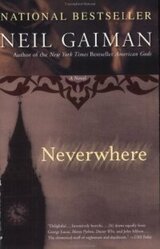
Richard Mayhew is a young man with a good heart and an ordinary life, which is changed forever when he stops to help a girl he finds bleeding on a London sidewalk. His small act of kindness propels him into a world he never dreamed existed. There are people who fall through the cracks, and Richard has become one of them. And he must learn to survive in this city of shadows and darkness, monsters and saints, murderers and angels, if he is ever to return to the London that he knew.
Авторы: Нил Гейман, Terry Pratchett & Neil Gaiman, Mike Carey, Glenn Fabry
To Varney, he said, «Not bad. So, ‘best bravo and guard,’ we want you to get yourself to the market tonight. We want you to do whatever you have to, to become that certain young lady’s personal bodyguard. Then, when you get the job, one thing you don’t forget. You may guard her from the rest of the world, but when we want her, we take her. Got it?»
Varney ran his tongue over the wreck of his teeth. «Are you bribing me?» he asked.
Mr. Vandemar had picked up the morning-star. He was pulling the chain apart, with his free hand, link by link, and dropping the bits of twisted metal onto the floor. Chink. «No,» said Mr. Vandemar. Chink. «We’re intimidating you.» Chink. «And if you don’t do what Mister Croup says, we’re . . . » chink » . . . hurting you . . . » chink » . . . very badly, before we’re . . . » chink » . . . killing you.»
«Ah,» said Varney. «Then I’m working for you, aren’t I?»
«Yes, you are,» said Mr. Croup. «I’m afraid we don’t have any redeeming features.»
«That doesn’t bother me,» said Varney.
«Good,» said Mr. Croup. «Welcome aboard.»
It was a large but elegant mechanism, built of polished walnut and oak, of brass and glass, copper and mirrors and carved and inlaid ivory, of quartz prisms and brass gears and springs and cogs. The whole thing was rather larger than a wide-screen television, although the actual screen itself was no more than six inches across. A magnifying lens placed across it increased the size of the picture. There was a large brass horn coming out of the side—the kind you could find on an antique gramophone. The whole mechanism looked rather like a combined television and video player might look, if it had been invented and built three hundred years ago by Sir Isaac Newton. Which was, more or less, exactly what it was.
«Watch,» said Door. She placed the wooden ball onto a platform. Lights shone through the machine and into the ball. It began to spin around and around,
A patrician face appeared on the small screen, vividly colored. Slightly out of time, a voice came from the horn, crackling in mid-speech. » . . . that two cities should be so near,» said the voice, «and yet in all things so far; the possessors above us, and the dispossessed, we who live below and between, who live in the cracks.»
Door stared at the screen, her face unreadable.
» . . . still,» said her father, «I am of the opinion that what cripples us, who inhabit the Underside, is our petty factionalism. The system of baronies and fiefdoms is both divisive and foolish.» The Lord Portico was wearing a threadbare old smoking jacket and a skullcap. His voice seemed to be coming to them across the centuries, not days or weeks. He coughed. «I am not alone in this belief. There are those who wish to see things the way they are. There are others who want the situation to worsen. There are those . . . »
«Can you speed it up?» asked the marquis. «Find the last entry?»
Door nodded. She touched an ivory lever at the side: the image ghosted, fragmented, re-formed.
Now Portico wore a long coat. His skullcap was gone. There was a scarlet gash down one side of his head. He was no longer sitting at his desk. He was talking urgently, quietly. «I do not know who will see this, who will find this. But whoever you are, please take this to my daughter, the Lady Door, if she lives . . . » A static burst wiped across the picture and the sound. Then, «Door? Girl, this is bad. I don’t know how long I’ve got before they find this room. I think my poor Portia and your brother and sister are dead.» The sound and picture quality began to degrade.
The marquis glanced at Door. Her face was wet: tears were brimming from her eyes, glistening down her cheeks. She seemed unaware that she was crying, made no attempt to wipe away the tears. She just stared at her father’s image, listened to his words. Crackle. Wipe. Crackle. «Listen to me, girl,» said her dead father. «Go to Islington . . . you can trust Islington . . . You must believe in Islington . . . » He ghosted. Blood dripped from his forehead into his eyes. He he wiped it off. «Door? Avenge us. Avenge your family.»
A loud bang came from the gramophone horn. Portico turned his head to look offscreen, puzzled and nervous. «What?» he said, and he stepped out of frame. For a moment, the picture remained unchanged: the desk, the blank white wall behind it. Then an arc of vivid blood splashed across the wall. Door flicked a lever on the side, blanking the screen, and turned away.
«Here.» The marquis passed her a handkerchief.
«Thanks.» She wiped her face, blew her nose vigorously. Then she stared into space. Eventually, she said, «Islington.»
«I’ve never