
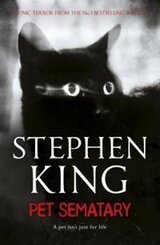
When the Creeds move into a beautiful old house in rural Maine, it all seems too good to be true: physician father, beautiful wife, charming little daughter, adorable infant son-and now an idyllic home. As a family, they’ve got it all…right down to the friendly cat. But the nearby woods hide a blood-chilling truth-more terrifying than death itself…and hideously more powerful.
Авторы: King Stephen Edwin
Louis long to see that his scalpel was missing, and he put his hands over his face and sat that way for some time, a faint, despairing noise coming from his throat.
At last he opened the bag again and began to look through it.
Downstairs again.
The sound of the pantry door being opened. The sound of a cupboard being opened, then slammed shut. The busy whine of the can opener. Last the sound of the garage door opening and closing. And then the house stood empty in the May sunshine, as it had stood empty on that August day the year before, waiting for the new people to arrive… as it would wait for other new people to arrive at some future date. A young married couple perhaps, with no children (but with hopes and plans). Bright young marrieds with a taste for Mondavi wine and Lцwenbrдu beer-he would be in charge of the Northeast Bank’s credit department perhaps, she with a dental hygienist’s credential or maybe three years’ experience as an optometrist’s assistant. He would split half a cord of wood for the fireplace, she would wear high-waisted corduroy pants and walk in Mrs.
Vinton’s field, collecting November’s fall grasses for a table centerpiece, her hair in a ponytail, the brightest thing under the gray skies, totally unaware that an invisible Vulture rode the air currents overhead. They would congratulate themselves on their lack of superstition, on their hardheadedness in snaring the house in spite of its history-they would tell their friends that it had been firesale-priced and joke about the ghost in the attic, and all of them would have another Lцwenbrдu or another glass of Mondavi, and they would play backgammon or Mile Bourne.
And perhaps they would have a dog.
Louis paused on the soft shoulder to let an Orinco truck loaded with chemical fertilizer blast by him, and then he crossed the street to Jud’s house, trailing his shadow to the west behind him. He held an open can of Cab catfood in one hand.
Church saw him coming and sat up, his eyes watchful.
“Hi, Church,” Louis said, surveying the silent house. “Want some grub?”
He put the can of catfood down on the trunk of the Chevette and watched as Church leaped lightly down from its roof and began to eat. Louis put his hand in his jacket pocket. Church looked around at him, tensing, as if reading his mind.
Louis smiled and stepped away from the car. Church began to eat again, and Louis took a syringe from his pocket. He stripped the paper covering from it and filled it with 75 milligrams of morphine. He put the multidose vial back in his jacket and walked over to Church, who looked around again mistrustfully. Louis smiled at the cat and said, “Go on, eat up, Church. Hey-ho, let’s go, right?” He stroked the cat, felt its back arch, and when Church went back to his meal again, Louis seized it around its stinking guts and sank the needle deep into its haunch.
Church went electric in his grip, struggling against him, spitting and clawing, but Louis held on and depressed the plunger all the way. Only then did he let go. The cat leaped off the Chevette, hissing like a teakettle, yellow-green eyes wild and baleful. The needle and syringe dangled from its haunch as it leaped, then fell out and broke. Louis was indifferent. He had more of everything.
The cat started for the road, then turned back toward the house, as if remembering something. It got halfway there and then began to weave drunkenly.
It made the steps, leaped up to the first one, then fell off. It lay on the bare patch at the foot of the porch steps on its side, breathing weakly.
Louis glanced into the Chevette. If he had needed more confirmation than the stone that had replaced his heart, he had it: Rachel’s purse on the seat, her scarf, and a clutch of plane tickets spilling out of a Delta Airlines folder.
When he turned around again to walk to the porch, Church’s side had ceased its rapid, fluttery movement. Church was dead. Again.
Louis stepped over it and mounted the porch steps.
“Gage?”
It was cool in the front hail. Cool and dark. The single word fell into the silence like a stone down a deep-drilled well. Louis threw another.
“Gage?”
Nothing. Even the tick of the clock in the parlor had ceased. This morning there had been no one to wind it.
But there were tracks on the floor.
Louis went into the living room. There was the smell of cigarettes, stale and long since burned out. He saw Jud’s chair by the window. It was pushed askew, as if he had gotten up suddenly. There was an ashtray on the windowsill, and in it a neat roll of cigarette ash.
Jud sat here watching. Watching for what? For me of course,