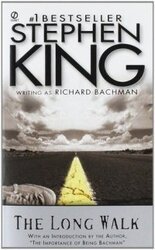
On the first day of May, one hundred teenage boys meet for an event known throughout the country as «The Long Walk.» If you break the rules, you get three warnings. If you exceed your limit, what happens is absolutely terrifying.
Авторы: King Stephen Edwin
Garraty felt a warm trickle of horror. “Baker? Have you gone nuts, Baker?”
“You cain’t beat it. We-uns was all crazy to try. You cain’t beat the rottenness of it. Not in this world. Lead-lined, that’s the ticket…”
“If you don’t get hold of yourself, you’ll be dead by morning.”
Baker nodded. His skin was drawn tight over his cheekbones, giving him the aspect of a skull. “That’s the ticket. I wanted to die. Didn’t you? Isn’t that why?”
“Shut up!” Garraty yelled. He had the shakes again.
The road sloped sharply up then, cutting off their talk. Garraty leaned into the hill, cold and hot, his spine hurting, his chest hurting. He was sure his muscles would flatly refuse to support him much longer. He thought of Baker’s lead-lined box, sealed against the dark millennia, and wondered if it would be the last thing he ever thought of. He hoped not, and struggled for some other mental track.
Warnings cracked out sporadically. The soldiers on the halftrack were back up to the mark; the one Parker had killed had been unobtrusively replaced. The crowd, cheered monotonously. Garraty wondered how it would be, to lie in the biggest, dustiest library silence of all, dreaming endless, thoughtless dreams behind gummed-down eyelids, dressed forever in your Sunday suit. No worries about money, success, fear, joy, pain, sorrow, sex, or love. Absolute zero. No father, mother, girlfriend, lover. The dead are orphans. No company but the silence like a moth’s wing. An end to the agony of movement, to the long nightmare of going down the road. The body in peace, stillness, and order. The perfect darkness of death.
How would that be? Just how would that be?
And suddenly his roiling, agonized muscles, the sweat running down his face, even the pain itself-seemed very sweet and real. Garraty tried harder. He struggled to the top of the hill and gasped raggedly all the way down the far side.
At 11:40 Marty Wyman bought his hole. Garraty had forgotten all about Wyman, who hadn’t spoken or gestured for the last twenty-four hours. He didn’t die spectacularly. He just lay down and got shot. And someone whispered, that was Wyman. And someone else whispered, that’s eighty-three, isn’t it? And that was all.
By midnight they were only eight miles from the New Hampshire border. They passed a drive-in theater, a huge white oblong in the darkness. A single slide blazed from the screen: THE MANAGEMENT OF THIS THEATRE SALUTES THIS YEAR’s LONG WALKERS! At 12:20 in the morning it began to rain again, and Abraham began to cough-the same kind of wet, ragged cough that had gotten Scramm not long before he bought out. By one o’clock the rain had become a hard, steady downpour that stung Garraty’s eyes and made his body ache with a kind of internal ague. The wind drove at their backs.
At quarter past the hour, Bobby Sledge tried to scutter quietly into the crowd under the cover of the dark and the driving rain. He was holed quickly and efficiently. Garraty wondered if the blond soldier who had almost sold him his ticket had done it. He knew the blond was on duty; he had seen his face clearly in the glare from the drive-in spotlights. He wished heartily that the blond had been the one Parker had ticketed.
At twenty of two Baker fell down and hit his head on the paving. Garraty started to go to him without even thinking. A hand, still strong, clamped on his arm. It was McVries. Of course it would have to be McVries.
“No,” he said. “No more musketeers. And now it’s real.”
They walked on without looking back.
Baker collected three warnings, and then the silence stretched out interminably. Garraty waited for the guns to come down, and when they didn’t, he checked his watch. Over four minutes had passed. Not long after, Baker walked past him and McVries, not looking at anything. There was an ugly, trickling wound on his forehead, but his eyes looked saner. The vacuous, dazed look was gone.
A little before two AM they crossed into New Hampshire amid the greatest pandemonium yet. Cannons went off. Fireworks burst in the rainy sky, lighting a multitude that stretched away as far as the eye could see in a crazy feverlight. Competing brass bands played martial airs. The cheers were thunder. A great overhead airburst traced the Major’s face in fire, making Garraty think numbly of God. This was followed by the face of the New Hampshire Provo Governor, a man known for having stormed the German nuclear base in Santiago nearly singlehanded back in 1953. He had lost a leg to radiation poisoning.
Garraty dozed again. His thoughts grew incoherent. Freaky D’Allessio was crouched beneath the rocking chair of Baker’s