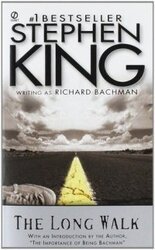
On the first day of May, one hundred teenage boys meet for an event known throughout the country as «The Long Walk.» If you break the rules, you get three warnings. If you exceed your limit, what happens is absolutely terrifying.
Авторы: King Stephen Edwin
crowd gathered in a supermarket parking lot they were just passing. “Everyone who wasn’t in shape is dead now, or almost dead. But there’s still seventy-two of us left.”
“Yeah, but…” A thinking frown spread over the broad circle of Scramm’s face. Garraty could almost hear the machinery up there working: slow, ponderous, but in the end as sure as death and as inescapable as taxes. It was somehow awesome.
“I don’t want to make you guys mad,” Scramm said. “You’re good guys. But you didn’t get into this thinking of winning out and getting the Prize. Most of these guys don’t know why they got into it. Look at that Barkovitch. He ain’t in it to get no Prize. He’s just walkin’ to see other people die. He lives on it. When someone gets a ticket, he gets a little more go-power. It ain’t enough. He’ll dry up just like a leaf on a tree.”
“And me?” Garraty asked.
Scramm looked troubled. “Aw, hell…”
“No, go on.”
“Well, the way I see it, you don’t know why you’re walking, either. It’s the same thing. You’re going now because you’re afraid, but… that’s not enough. That wears out.” Scramm looked down at the road and rubbed his hands together. “And when it wears out, I guess you’ll buy a ticket like all the rest, Ray.”
Garraty thought about McVries saying, When I get tired… really tired… why, l guess I will sit down.
“ You’ll have to walk a long time to walk me down,” Garraty said, but Scramm’s simple assessment of the situation had scared him badly.
“I,” Scramm said, “am ready to walk a long time.”
Their feet rose and fell on the asphalt, carrying them forward, around a curve, down into a dip and then over a railroad track that was metal grooves in the mad. They passed a closed fried clam shack. Then they were out in the country again.
“I understand what it is to die, I think,” Pearson said abruptly. “Now I do, anyway. Not death itself, I still can’t comprehend that. But dying. If I stop walking, I’ll come to an end.” He swallowed, and there was a click in his throat. “Just like a record after the last groove.” He looked at Scramm earnestly. “Maybe it’s like you say. Maybe it’s not enough. But… I don’t want to die.”
Scramm looked at him almost scornfully. “You think just knowing about death will keep you from dying?”
Pearson smiled a funny, sick little smile, like a businessman on a heaving boat trying to keep his dinner down. “Right now that’s about all that’s keeping me going.” And Garraty felt a huge gratefulness, because his defenses had not been reduced to that. At least, not yet.
Up ahead, quite suddenly and as if to illustrate the subject they had been discussing, a boy in a black turtleneck sweater suddenly had a convulsion. He fell on the mad and began to snap and sunfish and jackknife viciously. His limbs jerked and flopped. There was a funny gargling noise in his throat, aaa-aaa-aaa , a sheeplike sound that was entirely mindless. As Garraty hurried past, one of the fluttering hands bounced against his shoe and he felt a wave of frantic revulsion. The boy’s eyes were rolled up to the whites. There were splotches of foam splattered on his lips and chin. He was being second-warned, but of course he was beyond hearing, and when his two minutes were up they shot him like a dog.
Not long after that they reached the top of a gentle grade and stared down into the green, unpopulated country ahead. Garraty was grateful for the cool morning breeze that slipped over his fast-perspiring body.
“That’s some view,” Scramm said.
The road could be seen for perhaps twelve miles ahead. It slid down the long slope, ran in flat zigzags through the woods, a blackish-gray charcoal mark across a green swatch of crepe paper. Far ahead it began to climb again, and faded into the rosy-pink haze of early morning light.
“This might be what they call the Hainesville Woods,” Garraty said, not too sure. “Truckers’ graveyard. Hell in the wintertime.”
“I never seen nothing like it,” Scramm said reverently. “There isn’t this much green in the whole state of Arizona.”
“Enjoy it while you can,” Baker said, joining the group. “It’s going to be a scorcher. It’s hot already and it’s only six-thirty in the morning.”
“Think you’d get used to it, where you come from,” Pearson said, almost resentfully.
“You don’t get used to it,” Baker said, slinging his light jacket over his arm. “You just learn to live with it.”
“I’d like to build a house up here,” Scramm said. He sneezed heartily, twice, sounding a little like a bull in heat. “Build it right up here