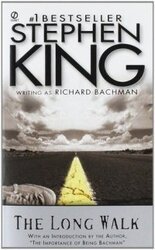
On the first day of May, one hundred teenage boys meet for an event known throughout the country as «The Long Walk.» If you break the rules, you get three warnings. If you exceed your limit, what happens is absolutely terrifying.
Авторы: King Stephen Edwin
o’clock, Garraty took inventory again.
One hundred and fifteen miles traveled. They were forty-five miles north of Oldtown, a hundred and twenty-five miles north of Augusta, the state capital, one hundred and fifty to Freeport (or more… he was terribly afraid there were more than twenty-five miles between Augusta and Freeport), probably two-thirty to the New Hampshire border. And the word was that this Walk was sure to go that far.
For a long while-ninety minutes or so-no one at all had been given a ticket. They walked, they half-listened to the cheers from the sidelines, and they stared at mile after monotonous mile of piney woods. Garraty discovered fresh twinges of pain in his left calf to go with the steady, wooden throbbing that lived in both of his legs, and the low-key agony that was his feet.
Then, around noon, as the day’s heat mounted toward its zenith, the guns began to make themselves heard again. A boy named Tressler, 92, had a sunstroke and was shot as he lay unconscious. Another boy suffered a convulsion and got a ticket. as he crawdaddied on the road, making ugly noises around his swallowed tongue. Aaronson, 1, cramped up in both feet and was shot on the white line, standing like a statue, his face turned up to the sun in neck-straining concentration. And at five minutes to one, another boy Garraty did not know had a sunstroke.
This is where I came in, Garraty thought, walking around the twitching, mumbling form on the road where the rifles sight in, seeing the jewels of sweat in the exhausted and soon-to-be-dead boy’s hair. This is where I came in, can’t I leave now?
The guns roared, and a covey of high school boys sitting in the scant shade of a Scout camper applauded briefly.
“I wish the Major would come through,” Baker said pettishly. “I want to see the Major.”
“What?” Abraham asked mechanically. He had grown gaunter in the last few hours. His eyes were sunk deeper in their sockets. The blue suggestion of a beard patched his face.
“So I can piss on him,” Baker said.
“Relax,” Garraty said. “Just relax.” All three of his warnings were gone now.
“You relax,” Baker said. “See what it gets you.”
“You’ve got no right to hate the Major. He didn’t force you.”
“Force me? FORCE me? He’s KILLING me, that’s all!”
“It’s still not-”
“Shut up,” Baker said curtly, and Garraty shut. He rubbed the back of his neck briefly and stared up into the whitish-blue sky. His shadow was a deformed huddle almost beneath his feet. He turned up his third canteen of the day and drained it.
Baker said: “I’m sorry. I surely didn’t mean to shout. My feet-”
“Sure,” Garraty said.
“We’re all getting this way,” Baker said. “I sometimes think that’s the worst part.”
Garraty closed his eyes. He was very sleepy.
“You know what I’d like to do?” Pearson said. He was walking between Garraty and Baker.
“Piss on the Major,” Garraty said. “Everybody wants to piss on the Major. When he comes through again we’ll gang up on him and drag him down and all unzip and drown him in-”
“That isn’t what I want to do.” Pearson was walking like a man in the last stages of conscious drunkenness. His head made half-rolls on his neck. His eyelids snapped up and down like spastic windowblinds. “It’s got nothin’ to do with the Major. I just want to go into the next field and lay down and close my eyes. Just lay there on my back in the wheat-”
“They don’t grow wheat in Maine,” Garraty said. “It’s hay.”
“-in the hay, then. And compose myself a poem. While I go to sleep.”
Garraty fumbled in his new foodbelt and found nothing in most of the pouches. Finally he happened on a waxpac of Saltines and began washing them down with water. “I feel like a sieve,” he said. “I drink it and it pops out on my skin two minutes later.”
The guns roared again and another figure collapsed gracelessly, like a tired jackin-the-box.
“Fordy fibe,” Scramm said, joining them. “I don’t thing we’ll even get to Pordland ad this rade.”
“You don’t sound so good,” Pearson said, and there might have been careful optimism in his voice.
“Luggy for me I god a good codstitution,” Scramm said cheerfully. “I thing I’be rudding a fever now.”
“Jesus, how do you keep going?” Abraham asked, and there was a kind of religious fear in his voice.
“Me? Talk about me?” Scramm said. “Look at hib! How does he keep going? Thad’s what I’d like to know!” And he cocked his thumb at Olson.
Olson had not spoken for two hours.