
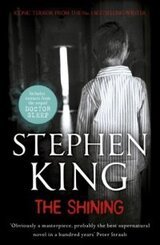
First published in 1977, The Shining quickly became a benchmark in the literary career of Stephen King.
Авторы: King Stephen Edwin
lost his football crackers nuts half a seabag)
all meaning the same thing: losing your mind.
“No,” he whimpered, hardly aware that he had been reduced to this, whimpering with his eyes shut like a child. “Oh no, God. Please, God, no.”
But below the tumble of his chaotic thoughts, below the triphammer beat of his heart, he could hear the soft and futile sound of the doorknob being turned to and fro as something locked in tried helplessly to get out, something that wanted to meet him, something that would like to be introduced to his family as the storm shrieked around them and white daylight became black night. If he opened his eyes and saw that doorknob moving he would go mad. So he kept them shut, and after an unknowable time, there was stillness.
Jack forced himself to open his eyes, half-convinced that when he did, she would be standing before him. But the hall was empty.
He felt watched just the same.
He looked at the peephole in the center of the door and wondered what would happen if he approached it, stared into ft. What would he be eyeball to eyeball with?
His feet were moving
(feets don’t fail me now)
before he realized it. He turned them away from the door and walked down to the main hall, his feet whispering on the blue-black jungle carpet. He stopped halfway to the stairs and looked at the fire extinguisher. He thought that the folds of canvas were arranged in a slightly different manner. And he was quite sure that the brass nozzle had been pointing toward the elevator when he came up the hall. Now it was pointing the other way.
“I didn’t see that at all,” Jack Torrance said quite clearly. His face was white and haggard and his mouth kept trying to grin.
But he didn’t take the elevator back down. It was too much like an open mouth. Too much by half. He took the stairs.
He stepped into the kitchen and looked at them, bouncing the passkey a few inches up off his left hand, making the chain on the white metal tongue jingle, then catching it again. Danny was pallid and worn out. Wendy had been crying, he saw; her eyes were red and darkly circled. He felt a sudden burst of gladness at this. He wasn’t suffering alone, that was sure.
They looked at him without speaking.
“Nothing there,” he said, astounded by the heartiness of his voice. “Not a thing.”
He bounced the passkey up and down, up and down, smiling reassuringly at them, watching the relief spread over their faces, and thought he had never in his life wanted a drink so badly as he did right now.
Late that afternoon Jack got a cot from the first-floor storage room and put it in the corner of their bedroom. Wendy had expected that the boy would be half the night getting to sleep, but Danny was nodding before “The Waltons” was half over, and fifteen minutes after they had tucked biro in he was far down in sleep, moveless, one band tucked under his cheek. Wendy sat watching him, holding her place in a fat paperback copy of Cashelmara with one finger. Jack sat at his desk, looking at his play.
“Oh shit,” Jack said.
Wendy looked up from her contemplation of Danny. “What?”
“Nothing.”
He looked down at the play with smoldering ill-temper. How could he have thought it was good? It was puerile. It had been done a thousand times. Worse, he had no idea how to finish it. Once it had seemed simple enough. Denker, in a fit of rage, seizes the poker from beside the fireplace and beats saintly Gary to death. Then, standing spread-legged over the body, the bloody poker in one hand, he screams at the audience: “It’s here somewhere and I will find it!” Then, as the lights dim and the curtain is slowly drawn, the audience sees Gary’s body face down on the forestage as Denker strides to the upstage bookcase and feverishly begins pulling books from the shelves, looking at them, throwing them aside. He bad thought it was something old enough to be new, a play whose novelty alone might be enough to see it through a successful Broadway run: a tragedy in five acts.
But, in addition to his sudden diversion of interest to the Overlooks history, something else had happened. He had developed opposing feelings about his characters. This was something quite new. Ordinarily he liked all of his characters, the good and the bad. He was glad he did. It allowed him to try to see all of their sides and understand their motivations more clearly. His favorite story, sold to a small southern Maine magazine called Contraband for copies, had been a piece called “The