
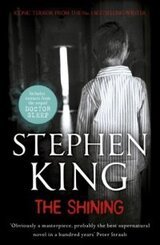
First published in 1977, The Shining quickly became a benchmark in the literary career of Stephen King.
Авторы: King Stephen Edwin
ago. All at once there was enough money left over at the end of each two-week pay period to start a little savings account. In his drinking days there had never been a penny left over, even though Al Shockley had stood a great many of the rounds. He and Wendy had begun to talk cautiously about finding a house and making a down payment in a year or so. A farmhouse in the country, take six or eight years to renovate it completely, what the hell, they were young, they had time.
Then he had lost his temper.
George Hatfield.
The smell of hope had turned to the smell of old leather in Crommert’s office, the whole thing like some scene from his own play: the old prints of previous Stovington headmasters on the walls, steel engravings of the school as it had been in 1879, when it was first built, and in 1895, when Vanderbilt money had enabled them to build the field house that still stood at the west end of the soccer field, squat, immense, dressed in ivy. April ivy had been rustling outside Crommert’s slit window and the drowsy sound of steam heat came from the radiator. It was no set, he remembered thinking. It was real. His life. How could he have fucked it up so badly?
“This is a serious situation, Jack. Terribly serious. The Board has asked me to convey its decision to you.”
The Board wanted lack’s resignation and Jack had given it to them. Under different circumstances, he would have gotten tenure that June.
What had followed that interview in Crommert’s office had been the darkest, most dreadful night of his life. The wanting, the needing to get drunk had never been so bad. His hands shook. He knocked things over. And he kept wanting to take it out on Wendy and Danny. His temper was like a vicious animal on a frayed leash. He had left the house in terror that he might strike them. Had ended up outside a bar, and the only thing that had kept him from going in was the knowledge that if he did, Wendy would leave him at last, and take Danny with her. He would be dead from the day they left.
Instead of going into the bar, where dark shadows sat sampling the tasty waters of oblivion, he had gone to Al Shockley’s house. The Board’s vote had been six to one. Al had been the one.
Now he dialed the operator and she told him that for a dollar eighty-five he could be put in touch with Al two thousand miles away for three minutes. Time is relative, baby, he thought, and stuck in eight quarters. Faintly he could hear the electronic boops and beeps of his connection sniffing its way eastward.
Al’s father had been Arthur Longley Shockley, the steel baron. He had left his only son, Albert, a fortune and a huge range of investments and directorships and chairs on various boards. One of these had been on the Board of Directors for Stovington Preparatory Academy, the old man’s favorite charity. Both Arthur and Albert Shockley were alumni and Al lived in Barre, close enough to take a personal interest in the school’s affairs. For several years Al had been Stovington’s tennis coach.
Jack and Al had become friends in a completely natural and uncoincidental way: at the many school and faculty functions they attended together, they were always the two drunkest people there. Shockley was separated from his wife, and Jack’s own marriage was skidding slowly downhill, although he still loved Wendy and had promised sincerely (and frequently) to reform, for her sake and for baby Danny’s.
The two of them went on from many faculty parties, hitting the bars until they closed, then stopping at some mom ‘n’ pot) store for a case of beer they would drink parked at the end of some back road. There were mornings when Jack would stumble into their leased house with dawn seeping into the sky and find Wendy and the baby asleep on the couch, Danny always on the inside, a tiny fist curled under the shelf of Wendy’s jaw. He would look at them and the self-loathing would back up his throat in a bitter wave, even stronger than the taste of beer and cigarettes and martinis-martians, as Al called them. Those were the times that his mind would turn thoughtfully and sanely to the gun or the rope or the razor blade.
If the bender had occurred on a weeknight, he would sleep for three hours, get up, dress, chew four Excedrins, and go off to teach his nine o’clock American Poets still drunk. Good morning, kids, today the Red-Eyed Wonder is going to tell you about how Longfellow lost his wife in the big fire.
He hadn’t believed he was an alcoholic, Jack thought as Al’s telephone began ringing in his ear. The classes he had missed or taught unshaven, still reeking of last night’s martians. Not me, I can stop anytime. The nights he and Wendy had passed in separate beds. Listen, I’m fine. Mashed fenders. Sure I’m okay to drive. The tears she always shed in the bathroom.