
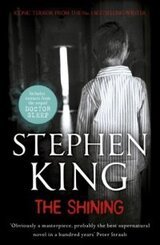
First published in 1977, The Shining quickly became a benchmark in the literary career of Stephen King.
Авторы: King Stephen Edwin
had almost thrown the envelope away, thinking it was a subscription offer. Opening it, she had found instead that it was a letter saying that Esquire would like to use Jack’s story “Concerning the Black Holes” early the following year. They would pay nine hundred dollars, not on publication but on acceptance. That was nearly half a year’s take typing papers and she had flown to the telephone, leaving Danny in his high chair to goggle comically after her, his face lathered with creamed peas and beef puree.
Jack had arrived from the university forty-five minutes later, the Buick weighted down with seven friends and a keg of beer. After a ceremonial toast (Wendy also had a glass, although she ordinarily had no taste for beer), Jack had signed the acceptance letter, put it in the return envelope, and went down the block to drop it in the letter box. When he came back he stood gravely in the door and said, “Veni, vidi, vici.” There were cheers and applause. When the keg was empty at eleven that night, Jack and the only two others who were still ambulatory went on to hit a few bars.
She had gotten him aside in the downstairs hallway. The other two were already out in the car, drunkenly singing the New Hampshire fight song. Jack was down on one knee, owlishly fumbling with the lacings of his moccasins.
“Jack,” she said, “you shouldn’t. You can’t even tie your shoes, let alone drive.”
He stood up and put his hands calmly on her shoulders. “Tonight I could fly to the moon if I wanted to.”
“No,” she said. “Not for all the Esquire stories in the world.”
“I’ll be home early.”
But he hadn’t been home until four in the morning, stumbling and mumbling his way up the stairs, waking Danny up when he came in. He had tried to soothe the baby and dropped him on the floor. Wendy had rushed out, thinking of what her mother would think if she saw the bruise before she thought of anything else- God help her, God help them both-and then picked Danny up, sat in the rocking chair with him, soothed him. She had been thinking of her mother for most of the five hours Jack had been gone, her mother’s prophecy that Jack would never come to anything. Big ideas, her mother had said. Sure. The welfare lines are full of educated fools with big ideas. Did the Esquire story make her mother wrong or right? Winnifred, you’re not holding that baby right. Give him to me. And was she not holding her husband right? Why else would he take his joy out of the house? A helpless kind of terror had risen up in her and it never occurred to her that he had gone out for reasons that had nothing to do with her.
“Congratulations,” she said, rocking Danny-he was almost asleep again. “Maybe you gave him a concussion.”
“It’s just a bruise.” He sounded sulky, wanting to be repentant: a little boy. For an instant she hated him.
“Maybe,” she said tightly. “Maybe not.” She heard so much of her mother talking to her departed father in her own voice that she was sickened and afraid.
“Like mother like daughter,” Jack muttered.
“Go to bed!” she cried, her fear coming out sounding like anger. “Go to bed, you’re drunk!”
“Don’t tell me what to do.”
“Jack… please, we shouldn’t… it…” There were no words.
“Don’t tell me what to do,” he repeated sullenly, and then went into the bedroom. She was left alone in the rocking chair with Danny, who was sleeping again. Five minutes later Jack’s snores came floating out to the living room. That had been the first night she had slept on the couch.
Now she turned restlessly on the bed, already dozing. Her mind, freed of any linear order by encroaching sleep, floated past the first year at Stovington, past the steadily worsening times that had reached low ebb when her husband had broken Danny’s arm, to that morning in the breakfast nook.
Danny outside playing trucks in the sandpile, his arm still in the cast. Jack sitting at the table, pallid and grizzled, a cigarette jittering between his fingers. She had decided to ask him for a divorce. She had pondered the question from a hundred different angles, had been pondering it in fact for the six months before the broken arm. She told herself she would have made the decision long ago if it hadn’t been for Danny, but not even that was necessarily true. She dreamed on the long nights when Jack was out, and her dreams were always of her mother’s face and of her own wedding.
(Who giveth this woman? Her father standing in his best suit which was none too good-he was a traveling salesman for a line of canned goods that even then was going broke-and his tired face, how old he looked, how pale: I do.)
Even after the accident-if you could call it an accident-she had not been able to bring it all the way out, to admit that her marriage was a lopsided defeat. She had