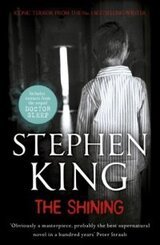
First published in 1977, The Shining quickly became a benchmark in the literary career of Stephen King.
Авторы: King Stephen Edwin
Hence George Hatfield. Now all that remained of those days was the play on the desk in his and Wendy’s bedroom, and when it was done and sent off to Phyllis’s hole-in-the-wall New York agency, he could turn to other things. Not a novel, he was not ready to stumble into the swamp of another three-year undertaking, but surely more short stories. Perhaps a book of them.
Moving warily, he scrambled back down the slope of the roof on his hands and knees past the line of demarcation where the fresh green Bird shingles gave way to the section of roof he had just finished clearing. He came to the edge on the left of the wasps’ nest he had uncovered and moved gingerly toward it, ready to backtrack and bolt down his ladder to the ground if things looked too hot.
He leaned over the section of pulled-out flashing and looked in.
The nest was in there, tucked into the space between the old flashing and the final roof undercoating of three-by-fives. It was a damn big one. The grayish paper ball looked to Jack as if it might be nearly two feet through the center. Its shape was not perfect because the space between the flashing and the boards was too narrow, but he thought the little buggers had still done a pretty respectable job. The surface of the nest was acrawl with the lumbering, slowmoving insects. They were the big mean ones, not yellow jackets, which are smaller and calmer, but wall wasps. They had been rendered sludgy and stupid by the fall temperatures, but Jack, who knew about wasps from his childhood, counted himself lucky that he had been stung only once. And, he thought, if Ullman had hired the job done in the height of summer, the workman who tore up that particular section of the flashing would have gotten one hell of a surprise. Yes indeedy. When a dozen wall wasps land on you all at once and start stinging your face and hands and arms, stinging your legs right through your pants, it would be entirely possible to forget you were seventy feet up. You might just charge right off the edge of the roof while you were trying to get away from them. All from those little things, the biggest of them only half the length of a pencil stub.
He had read someplace-in a Sunday supplement piece or a back-of-the-book newsmagazine article-that 7 per cent of all automobile fatalities go unexplained. No mechanical failure, no excessive speed, no booze, no bad weather. Simply one-car crashes on deserted sections of road, one dead occupant, the driver, unable to explain what had happened to him. The article had included an interview with a state trooper who theorized that many of these so-called “foo crashes” resulted from insects in the car. Wasps, a bee, possibly even a spider or moth. The driver gets panicky, tries to swat it or unroll a window to let it out. Possibly the insect stings him. Maybe the driver just loses control. Either way it’s bang!.,. all over. And the insect, usually completely unharmed, would buzz merrily out of the smoking wreck, looking for greener pastures. The trooper had been in favor of having pathologists look for insect venom while autopsying such victims, Jack recalled.
Now, looking down into the nest, it seemed to him that it could serve as both a workable symbol for what he had been through (and what he had dragged his hostages to fortune through) and an omen for a better future. How else could you explain the things that had happened to him? For he still felt that the whole range of unhappy Stovington experiences had to be looked at with Jack Torrance in the passive mode. He had not done things; things had been done to him. He had known plenty of people on the Stovington faculty, two of them right in the English Department, who were hard drinkers. Zack Tunney was in the habit of picking up a full keg of beer on Saturday afternoon, plonking it in a backyard snowbank overnight, and then killing damn near all of it on Sunday watching football games and old movies. Yet through the week Zack was as sober as a judge-a weak cocktail with lunch was an occasion.
He and Al Shockley had been alcoholics. They had sought each other out like two castoffs who were still social enough to prefer drowning together to doing it alone. The sea had been whole-grain instead of salt, that was all. Looking down at the wasps, as they slowly went about their instinctual business before winter closed down to kill all but their hibernating queen, he would go further. He was still an alcoholic, always would be, perhaps had been since Sophomore Class Night in high school when he had taken his first drink. It had nothing to do with willpower, or the morality of drinking, or the weakness or strength of his own character. There was a broken switch somewhere inside, or a circuit breaker that didn’t work, and he had been propelled down the chute willynilly, slowly