
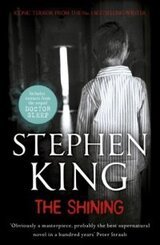
First published in 1977, The Shining quickly became a benchmark in the literary career of Stephen King.
Авторы: King Stephen Edwin
with his arm in a cast)
–he does things he’s sorry for later.
Wendy blinked her eyes savagely hard, driving her tears all the way back.
“Something like that, honey. Your daddy hit George to make him stop cutting the tires and George hit his head. Then the men who are in charge of the school said that George couldn’t go there anymore and your daddy couldn’t teach there anymore.” She stopped, out of words, and waited in dread for the deluge of questions.
“Oh,” Danny said, and went back to looking up the street. Apparently the subject was closed. If only it could be closed that easily for her-
She stood up. “I’m going upstairs for a cup of tea, doc. Want a couple of cookies and a glass of milk?”
“I think I’ll watch for Dad.”
“I don’t think he’ll be home much before five.”
“Maybe he’ll be early.”
“Maybe,” she agreed. “Maybe he will.”
She was halfway up the walk when he called, “Mommy?”
“What, Danny?”
“Do you want to go and live in that hotel for the winter?”
Now, which of five thousand answers should she give to that one? The way she had felt yesterday or last night or this morning? They were all different, they crossed the spectrum from rosy pink to dead black.
She said: “If it’s what your father wants, it’s what I want.” She paused. “What about you?”
“I guess I do,” he said finally. “Nobody much to play with around here.”
“You miss your friends, don’t you?”
“Sometimes I miss Scott and Andy. That’s about all.”
She went back to him and kissed him, rumpled his lightcolored hair that was just losing its baby-fineness. He was such a solemn little boy, and sometimes she wondered just how he was supposed to survive with her and Jack for parents. The high hopes they had begun with came down to this unpleasant apartment building in a city they didn’t know. The image of Danny in his cast rose up before her again. Somebody in the Divine Placement Service had made a mistake, one she sometimes feared could never be corrected and which only the most innocent bystander could pay for.
“Stay out of the road, doc,” she said, and hugged him tight.
“Sure, Mom.”
She went upstairs and into the kitchen. She put on the teapot and laid a couple of Oreos on a plate for Danny in case he decided to come up while she was lying down. Sitting at the table with her big pottery cup in front of her, she looked out the window at him, still sitting on the curb in his bluejeans and his over-sized dark green Stovington Prep sweatshirt, the glider now lying beside him. The tears which had threatened all day now came in a cloudburst and she leaned into the fragrant, curling steam of the tea and wept. In grief and loss for the past, and terror of the future.
You lost your temper, Ullman had said.
“Okay, here’s your furnace,” Watson said, turning on a light in the dark, musty-smelling room. He was a beefy man with fluffy popcorn hair, white shirt, and dark green chinos. He swung open a small square grating in the furnace’s belly and he and Jack peered in together. “This here’s the pilot light.” A steady blue-white jet hissing steadily upward channeled destructive force, but the key word, Jack thought, was destructive and not channeled: if you stuck your hand in there, the barbecue would happen in three quick seconds.
Lost your temper.
(Danny, are you all right?)
The furnace filled the entire room, by far the biggest and oldest Jack had ever seen.
“The pilot’s got a fail-safe,” Watson told him. “Little sensor in there measures heat. If the heat falls below a certain point, it sets off a buzzer in your quarters. Boiler’s on the other side of the wall. I’ll take you around.” He slammed the grating shut and led Jack behind the iron bulk of the furnace toward another door. The iron radiated a stuporous heat at them, and for some reason Jack thought of a large, dozing cat. Watson jingled his keys and whistled.
Lost your-
(When he went back into his study and saw Danny standing there, wearing nothing but his training pants and a grin, a slow, red cloud of rage had eclipsed Jack’s reason. It had seemed slow subjectively, inside his head, but it must have all happened in less than a minute. It only seemed slow the way some dreams seem slow. The bad ones. Every door and drawer in his study seemed to have been ransacked in the time he had been gone. Closet, cupboards, the sliding bookcase. Every desk drawer yanked out to the stop. His manuscript, the threeact play he had been slowly developing from a novelette he had written seven years ago as an under-graduate, was scattered all over the floor. He had been drinking a beer and