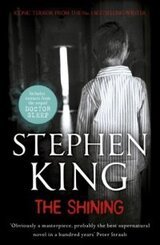
First published in 1977, The Shining quickly became a benchmark in the literary career of Stephen King.
Авторы: King Stephen Edwin
against the door, and let Danny amuse himself by sledding to the right and left of the path. The truly heroic drifts lay against the Overlook’s west side; some of them towered to a height of twenty feet, and beyond them the ground was scoured bare to the grass by the constant windflow. The first-floor windows were covered, and the view from the dining room which Jack had so admired on closing day was now no more exciting than a view of a blank movie screen. Their phone had been out for the last eight days, and the CB radio in Ullman’s office was now their only communications link with the outside world.
It snowed every day now, sometimes only brief flurries that powdered the glittering snow crust, sometimes for real, the low whistle of the wind cranking up to a womanish shriek that made the old hotel rock and groan alarmingly even in its deep cradle of snow. Night temperatures had not gotten above 10°, and although the thermometer by the kitchen service entrance sometimes got as high as 25° in the early afternoons, the steady knife edge of the wind made it uncomfortable to go out without a ski mask. But they all did go out on the days when the sun shone, usually wearing two sets of clothing and mittens on over their gloves. Getting out was almost a compulsive thing; the hotel was circled with the double track of Danny’s Flexible Flyer. The permutations were nearly endless: Danny riding while his parents pulled; Daddy riding and laughing while Wendy and Danny tried to pull (it was just possible for them to pull him on the icy crust, and flatly impossible when powder covered it); Danny and Mommy riding; Wendy riding by herself while her menfolk pulled and puffed white vapor like drayhorses, pretending she was heavier than she was. They laughed a great deal on these sled excursions around the house, but the whooping and impersonal voice of the wind, so huge and hollowly sincere, made their laughter seem tinny and forced.
They had seen caribou tracks in the snow and once the caribou themselves, a group of five standing motionlessly below the security fence. They had all taken turns with Jack’s Zeiss-Ikon binoculars to see them better, and looking at them had given Wendy a weird, unreal feeling: they were standing leg-deep in the snow that covered the highway, and it came to her that between now and the spring thaw, the road belonged more to the caribou than it did to them. Now the things that men had made up here were neutralized. The caribou understood that, she believed. She had put the binoculars down and had said something about starting lunch and in the kitchen she had cried a little, trying to rid herself of the awful pent-up feeling that sometimes fell on her like a large, pressing hand over her heart. She thought of the caribou. She thought of the wasps Jack had put out on the service entrance platform, under the Pyrex bowl, to freeze.
There were plenty of snowshoes hung from nails in the equipment shed, and Jack found a pair to fit each of them, although Danny’s pair was quite a bit outsized. Jack did well with them. Although he had not snowshoed since his boyhood in Berlin, New Hampshire, he retaught himself quickly. Wendy didn’t care much for it-even fifteen minutes of tramping around on the outsized laced paddles made her legs and ankles ache outrageously-but Danny was intrigued and working hard to pick up the knack. He still fell often, but lack was pleased with his progress. He said that by February Danny would be skipping circles around both of them.
This day was overcast, and by noon the sky had already begun to spit snow. The radio was promising another eight to twelve inches and chanting hosannas to Precipitation, that great god of Colorado skiers. Wendy, sitting in the bedroom and knitting a scarf, thought to herself that she knew exactly what the skiers could do with all that snow. She knew exactly where they could put it.
Jack was in the cellar. He had gone down to check the furnace and boiler-such checks had become a ritual with him since the snow had closed them in-and after satisfying himself that everything was going well he had wandered through the arch, screwed the lightbulb on, and had seated himself in an old and cobwebby camp chair he had found. He was leafing through the old records and papers, constantly wiping his mouth with his handkerchief as he did so. Confinement had leached his skin of its autumn tan, and as he sat hunched over the yellowed, crackling sheets, his reddish-blond hair tumbling untidily over his forehead, he looked slightly lunatic. He had found some odd things tucked in among the invoices, bills of lading, receipts. Disquieting things. A bloody strip of sheeting. A dismembered teddy bear that seemed to have been slashed to pieces. A crumpled