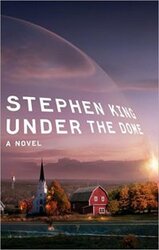
On an entirely normal, beautiful fall day in Chester’s Mill, Maine, the town is inexplicably and suddenly sealed off from the rest of the world by an invisible force field.
Авторы: King Stephen Edwin
grabbing or blatting.
Frankie wasn’t smiling now. ‘You want to watch that shit,’ he said. ‘Things are different now.’
‘What are you going to do? Arrest me?’
‘I’d think of something better than that,’ he said.’Go on, get out of here. And if you do see Angie, tell her I want to see her.’
She drove away, mad and—she didn’t like to admit this to herself, but it was true—a little frightened. Half a mile down the road she pulled over and changed Little Walter’s diaper. There was a used diaper bag in back, but she was too mad to bother. She threw the shitty Pamper onto the shoulder of the road instead, not far from the big sign reading:
JIM RENNIE’S USED CARS
FOREIGN & DOMESTIC
A$K U$ 4 CREDIT!
YOU’LL BE WHEELIN’ BECAUSE BIG JIM IS DEALIN’!
She passed some kids on bikes and wondered again how long it would be before everyone was riding them. Except it: wouldn’t come to that. Someone would figure things out before it did, just like in one of those disaster movies she enjoyed watching on TV while she was stoned: volcanoes erupting in LA, zombies in New York. And when things went back to normal, Frankie and Carter Thibodeau would revert to what they’d been before: smalltown losers with little or no jingle in their pockets. In the meantime, though, she might do well to keep a low profile.
All in all, she was glad she’d kept her mouth shut about Dodee.
8
Rusty listened to the blood-pressure monitor begin its urgent beeping and knew they were losing the boy. Actually they’d been losing him ever since the ambulance—hell, from the moment the ricochet struck him—but the sound of the monitor turned the truth into a headline. Rory should have been Life-Flighted to CMG immediately, right from where he’d been so grievously wounded. Instead he was in an under-equipped operating room that was too warm (the airconditioning had been turned off to conserve the generator), being operated on by a doctor who should have retired years ago, a physician’s assistant who had never assisted in a neurosurgery case, and a single exhausted nurse who spoke up now.
‘V-fib, Dr Haskell.’
The heart monitor had joined in. Now it was a chorus.
‘I know, Ginny. I’m not death.’ He paused. ‘Deaf, I mean. Christ.’
For a moment he and Rusty looked at each other over the boy’s sheet-swaddled form. Haskell’s eyes were clear and with-it—this was not the same stethoscope-equipped time-server who had been plodding through the rooms and corridors of Cathy Russell for the last couple of years like a dull ghost—but he looked terribly old and frail.
‘We tried,’ Rusty said.
In truth, Haskell had done more than try; he’d reminded Rusty of one of those sports novels he’d loved as a kid, where the aging pitcher comes out of the bullpen for one more shot at glory in the seventh game of the World Series. But only Rusty and Ginny Tomlinson had been in the stands for this performance, and this time there would be no happy ending for the old warhorse.
Rusty had started the saline drip, adding mannitol to reduce brain swelling. Haskell had left the OR at an actual run to do the bloodwork in the lab down the hall, a complete CBC. It had to be Haskell; Rusty was unqualified and there were no lab techs. Catherine Russell was now hideously understaffed. Rusty thought the Dinsmore boy might be only a down payment on the price the town would eventually have to pay for that lack of personnel.
It got worse. The boy was A-negative, and they had none in their small blood supply. They did, however, have O-negative—the universal donor—and had given Rory four units, which left exactly nine more in supply. Giving it to the boy had probably been tantamount to pouring it down the scrub-room drain, but none of them had said so. While the blood ran into him, Haskell sent Ginny down to the closet-sized cubicle that served as the hospital’s library. She came back with a tattered copy of On Neurosurgery: A Brief Overview. Haskell operated with the book beside him, an otiscope laid across the pages to hold them down. Rusty thought he would never forget the whine of the saw, the smell of the bone dust in the unnaturally warm air, or the clot of jellied blood that oozed out after Haskell removed the bone plug.
For a few minutes, Rusty had actually allowed himself to hope. With the pressure of the hematoma relieved by the burr-hole, Rory’s vital signs had stabilized—or tried to. Then, while Haskell was attempting to determine if the bullet fragment was within his reach, everything had started going downhill again, and fast.
Rusty thought of the parents, waiting and hoping against hope. Now, instead of wheeling Rory to the left outside the OR—toward Cathy Russell’s